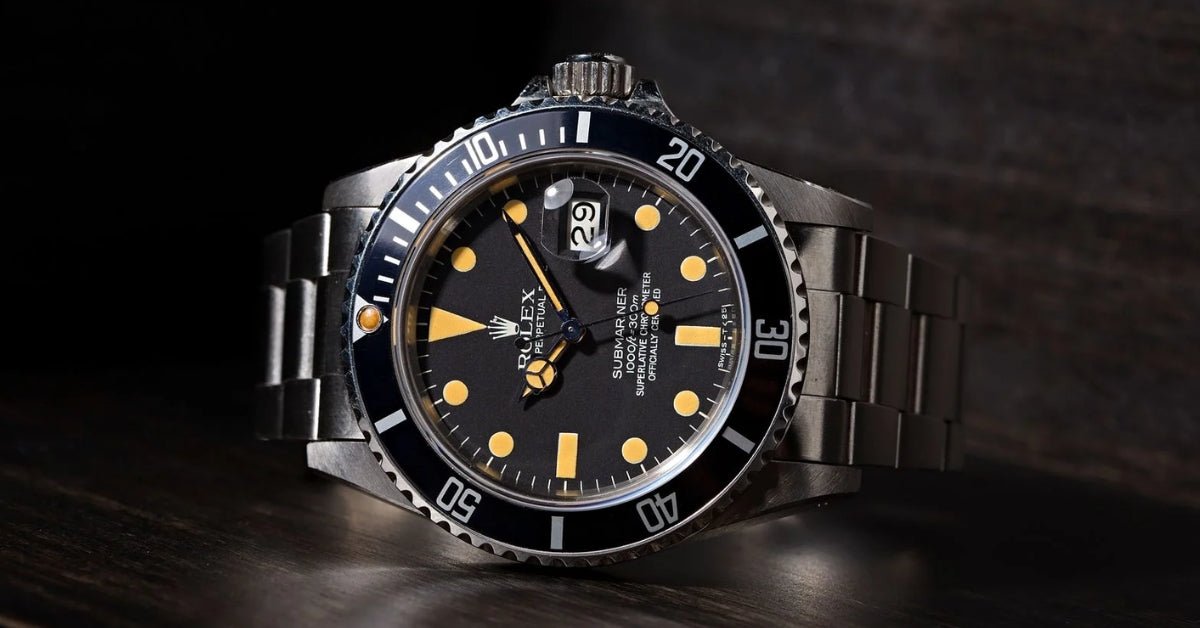
El 16800 es el Submariner que dejó de ser vintage y se volvió moderno, y lo logró al mismo tiempo. Cristal de zafiro por primera vez. Resistencia al agua duplicada a 300 m, impresa directamente en la esfera. Un bisel unidireccional y una fecha de ajuste rápido. Y en los primeros, una esfera negra mate con marcadores de tritio pintados que ahora brillan del color del papel viejo.
Esa combinación es la razón por la que la gente los compra y, lo que es más importante, por qué la gente realmente los usa. Un 16800 no es una pieza de colección. Es el Submariner vintage con el que puedes nadar sin tener una conversación contigo mismo primero, lo que lo convierte en uno de los mejores candidatos para correas de caucho en todo el catálogo de Rolex.
Tamaño y ajuste de la correa para el Submariner 16800
El 16800 tiene una caja de 40 mm con un ancho de asa de 20 mm.
Este es el número que la gente confunde, porque el Submariner no lo mantuvo. Todos los Submariner de cinco dígitos y anteriores —el 5512, 5513, 1680, 16800 y 16610— tienen 20 mm. La generación de cerámica de seis dígitos, el 116610 y el 126610, pasó a 21 mm y una caja más ancha. Una correa de 21 mm no le quedará a tu 16800, y tampoco se verá "lo suficientemente cerca".
Así que, cuando hagas tu pedido en Helvetus, selecciona Submariner 40mm. No 41mm. Esa única opción desplegable lo es todo:
→ Todas las correas de caucho para el Rolex Submariner
Una recomendación honesta sobre las hebillas. Opta por la versión con hebilla de pasador. Las correas desplegables están diseñadas para el cierre desplegable moderno de Rolex, y tu 16800 venía con el brazalete Oyster de la época con un cierre Fliplock, un animal completamente diferente. La versión con hebilla de pasador incluye su propia hebilla de acero, se ajusta correctamente y significa que no tendrás que devolver nada. Si prefieres verificar dos veces con tu cierre específico antes de hacer el pedido, el soporte te informará directamente.
Por qué el 16800 es importante
Rolex lo fabricó desde 1979 hasta finales de los años 80, ubicándolo entre el 1680 con cristal acrílico y el efímero 168000 que le siguió.
Se le llama referencia de transición por una buena razón. La ingeniería avanzó —zafiro, 300 m, bisel unidireccional, el calibre 3035 con su mayor frecuencia de latido y fecha de ajuste rápido— mientras que el aspecto se mantuvo firmemente en el viejo mundo. Inserto de bisel de aluminio. Luminiscencia de tritio. Proporciones de caja que aún no se habían inflado.
La esfera es donde se divide en dos. La producción temprana utilizaba esferas negras mate con marcadores de tritio pintados que se asientan planos en la superficie. La producción posterior pasó a esferas brillantes con marcadores aplicados. Ambas son correctas, ambas son 16800, y las mate tienen un valor superior. De cualquier manera, ese tritio ha pasado cuarenta años volviéndose color crema, y es lo más insustituible del reloj.
Brazalete original: el 93150 Oyster, con eslabones finales 593 o posteriores 501B y un cierre Fliplock con extensión de buceo.
Por qué los propietarios de esta referencia lo ponen en caucho
El 93150 tiene eslabones centrales huecos, y los eslabones huecos se estiran. Esto no es un defecto, es simplemente cómo se construyeron los brazaletes Oyster desde mediados de los setenta en adelante. Pero el estiramiento se acumula, nunca se revierte, y es una de las primeras cosas que un comprador o distribuidor revisa. Cada día que usas el reloj con fuerza con el brazalete es un día de desgaste que no puedes deshacer.
El tritio tampoco regresa. El sudor, el agua salada, el protector solar y las juntas de cuarenta años no son una gran combinación. El caucho es la correa que puedes enjuagar bajo el grifo y olvidarte de ella, y es la razón por la que un 16800 puede volver a hacer el trabajo para el que fue diseñado.
Y las asas están perforadas. Esta es la ventaja silenciosa del 16800 sobre cualquier Submariner moderno. Empujas las barras de resorte desde el exterior con un pasador, el brazalete se quita en menos de un minuto y nunca acercas una herramienta a las caras internas de las asas. Sin destornillador resbalado, sin arañazos en una caja que vale más sin pulir. Cambiar las correas en esta referencia es realmente más fácil que en un reloj fabricado el año pasado.
El brazalete se queda en la caja, correcto para la época y sin estirar, y el reloj se usa.
Cuatro colores de correa que le quedan bien al 16800
1. Negro — el uniforme de buzo
El caucho negro en un Submariner de esfera negra no es una elección creativa, es la correcta. Coloca el reloj de nuevo en su contexto original, mantiene la atención en la esfera y el bisel, y permite que la pátina que tengas hable por sí misma sin que nada compita.
También es la primera que debes comprar si el objetivo de la correa es realmente usar el reloj: playa, barco, piscina, gimnasio. Esta es esa correa.
→ Correa de caucho negra para el Rolex Submariner
2. Beige — la que combina con la luminiscencia
Esta es la elección que la mayoría de los propietarios del 16800 no han considerado. Cuarenta años de tritio han convertido tus marcadores y manecillas en un cálido tono crema, y el caucho beige lo realza exactamente. De repente, el envejecimiento de la esfera se interpreta como una decisión de diseño en lugar de un accidente químico.
Es lo más "correctamente vintage" que le puedes poner a este reloj sin comprar un brazalete de época, y se ve mucho mejor en persona de lo que suena en una pantalla. Si tu luminiscencia se ha vuelto realmente cremosa o de tono calabaza, esta es la indicada.
→ Correa de caucho beige para el Rolex Submariner
3. Azul — para un bisel descolorido
Muchos insertos de aluminio de los años 80 se han alejado del negro puro a lo largo de las décadas, volviéndose grises, ligeramente ciruela o un toque azul-negro a la luz del día. Si el tuyo lo ha hecho, una correa azul deja de luchar contra ello y empieza a trabajar con él. El inserto se lee como intencional, y todo el reloj se ve más claro y veraniego de lo que permite una correa negra.
Comprueba el tuyo en el exterior con luz real antes de decidir. Un inserto verdaderamente negro no necesita esto. Uno descolorido se transforma con él.
→ Correa de caucho azul para el Rolex Submariner
4. Blanco — contraste máximo
El enfoque opuesto, y funciona por una razón específica en esta referencia: una correa blanca resalta el dial negro mate y los marcadores crema. Todo lo impreso en ese dial, incluida la línea "1000 ft = 300 m" que introdujo el 16800, se vuelve más nítido.
Es una correa para clima cálido y no es sutil, pero en un reloj de buceo de cuarenta años se ve segura en lugar de delicada.
→ Correa de caucho blanca para el Rolex Submariner
Más colores, incluyendo las opciones LuxLine® con una línea de color a lo largo de la correa, se encuentran en la colección Submariner — solo recuerda seleccionar Submariner 40mm.
Misma caja, mismo ajuste
Si tienes uno de estos, nada cambia:
- 16803 — la versión de acero y oro bicolor del mismo reloj. 40mm, 20mm.
- 16808 — la versión completa de oro amarillo. Misma caja, mismo ancho de 20mm.
- 168000 — el breve "Triple Cero" que le siguió. También 40mm y 20mm.
- 1680 — el predecesor de cristal acrílico, también de 20mm.
- 116610 / 126610 — los Submariner de cerámica modernos. Estos son de 21mm, así que no hagas el pedido a partir de esta guía.
Respuestas rápidas
¿Qué ancho de asa tiene el Rolex Submariner 16800? 20 mm. La caja es de 40 mm y el espacio entre las asas es de 20 mm.
¿Qué debo seleccionar al hacer el pedido? Submariner 40mm. No 41mm — esa es la generación de cerámica moderna y lleva 21mm.
¿Hebilla de pasador o desplegable? Hebilla de pasador. La versión desplegable está diseñada para el cierre desplegable moderno de Rolex, no para el cierre Fliplock vintage con el que venía tu 16800.
¿Cambiar la correa es arriesgado en un Submariner vintage? Menos que en uno moderno. El 16800 tiene orificios perforados en las asas, por lo que las barras de resorte salen desde el exterior sin que ninguna herramienta toque el interior de las asas.
Antes de pedir
En un reloj tan antiguo, lo que se protege es la originalidad: el brazalete, las asas, la esfera. Una correa que se ajusta correctamente favorece los tres aspectos a la vez.
Las correas Helvetus para el Submariner están cortadas para la caja de 40 mm, vienen con una garantía de por vida en el caucho, se envían gratis a todo el mundo sin costes de importación y son usadas por más de 50.000 clientes. Guarda el 93150 en la caja, y vuelve a meter el 16800 en el agua.