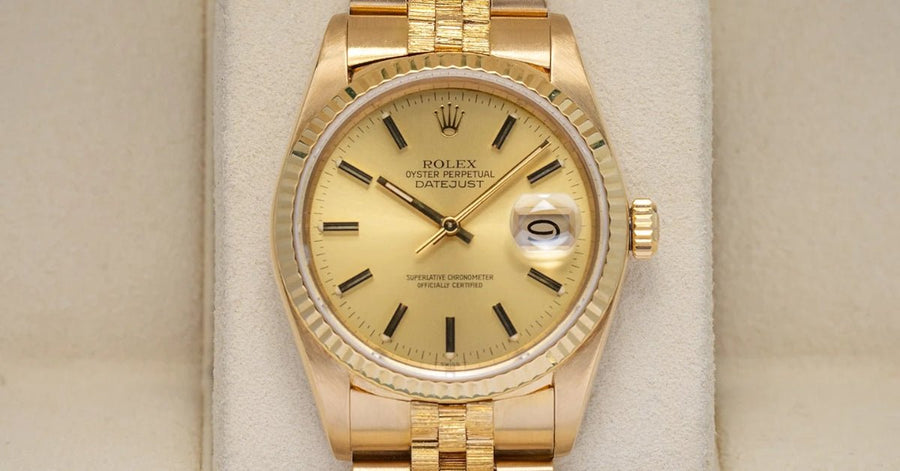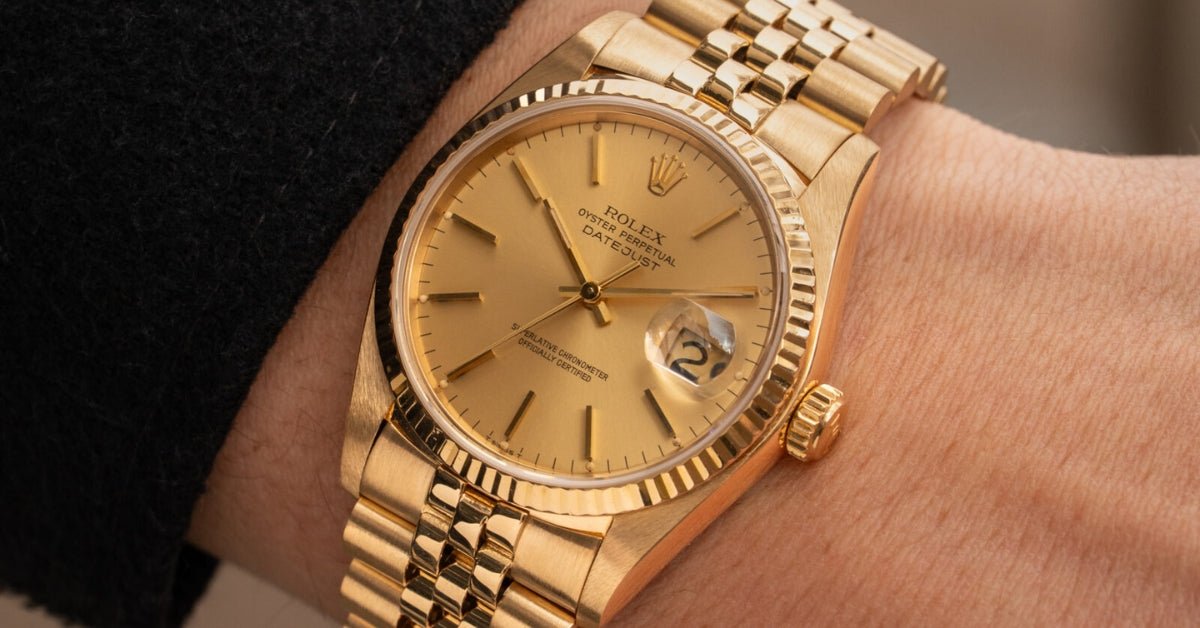
El 16018 es el tope de gama de los Datejust de cinco dígitos y del que menos se escribe. Caja maciza de oro amarillo de 18k, bisel estriado de oro, brazalete Jubilee de oro, fabricado desde 1977 hasta finales de los 80; la versión totalmente de oro de la familia de referencia que también nos dio el 16000 de acero, el 16013 bicolor y el 16030 con acabado "engine-turned".
También es uno de los relojes de 36 mm más pesados que puedes tener. Los registros de subasta para los 16018 individuales los listan en aproximadamente 125 a 137 gramos. Esa es toda la justificación para una correa, y volveremos a ello.
Tamaño y ajuste de la correa para el Datejust 36 (16018)
El 16018 tiene una caja de 36 mm con un ancho de asas de 20 mm, y unos 12 mm de grosor.
En Helvetus no hay talla que seleccionar; cada correa de la colección Datejust 36 está hecha para esta caja:
→ Todas las correas de caucho para el Rolex Datejust 36
Elige la versión con hebilla de pasador. Hay dos razones aquí. Las correas desplegables están diseñadas alrededor del moderno cierre desplegable de Rolex, y tu 16018 venía con un cierre de oro de época, usualmente oculto, a veces de tipo plegable simple. Y una hebilla de pasador significa que un cierre de oro macizo de 18k nunca más se manipulará, lo cual en esta referencia importa más que la cuestión del ajuste.
Qué es el 16018
Todo de oro amarillo macizo de 18k: caja Oyster de 36 mm con asas hacia abajo, bisel estriado de oro, corona y fondo atornillados, brazalete Jubilee de oro. Resistente al agua hasta 100 m.
En su interior se encuentra el calibre 3035 con 27 rubíes, fecha de ajuste rápido y segundos de parada, y fue el primer movimiento montado en un Datejust para hombre en funcionar a 28.800 alternancias por hora, en comparación con las 19.800 del calibre al que sustituyó. Ese cambio es la razón por la que existen las referencias 160xx.
Las esferas eran de champán (lisas, con efecto "sunburst" y "tapestry"), plata, negro, ónix y una variedad de ejecuciones con diamantes. Beckertime considera que el 160xx es una de las áreas menos representadas del mundo vintage de los Datejust, y el 16018 especialmente, lo cual es la forma educada de decir que un Rolex de oro macizo aquí cuesta menos de lo que esperarías.
Primero: averigua de qué está hecho tu cristal
Esto vale dos minutos antes de comprar cualquier cosa, y realmente está sin resolver.
La mayoría de las referencias 160xx de cinco dígitos utilizan un cristal de acrílico; esto está bien establecido para las versiones de acero y bicolor. Pero los distribuidores no están de acuerdo sobre las de oro específicamente. Un distribuidor de referencia afirma rotundamente que los modelos 160xx de oro de 18k venían con zafiro en lugar de acrílico. Otro, describiendo un 16018 de oro de 1985 que tenía en sus manos, lo enumera como acrílico. Ambos tipos están ciertamente disponibles ahora, ya que cuarenta y tantos años de servicio han intercambiado muchos en ambas direcciones.
Cómo distinguirlos: el acrílico es abovedado y de aspecto ligeramente suave, calienta y dobla la luz en el borde de la esfera, y se raya con casi nada. El zafiro es más plano, refleja más intensamente y resiste los arañazos por completo.
Por qué importa: un cristal acrílico es la única parte de este reloj que puedes restaurar tú mismo: un paño y un poco de pulimento eliminan los arañazos en minutos. El zafiro no se raya, pero cuando lo hace, se astilla y debe ser reemplazado.
De cualquier manera, el cristal es la única superficie indulgente del reloj. Lo que nos lleva a todo lo demás.
Por qué un Datejust de oro macizo debe llevar correa de caucho
Por el peso, y aquí el número es real. Los 16018 individuales han sido catalogados entre 125 y 137 gramos. Un Datejust de acero del mismo tamaño está muy por debajo de eso. Casi toda la diferencia es el brazalete, porque un Jubilee de oro macizo son docenas de gramos de metal envueltos alrededor de tu muñeca. Quítalo y el reloj deja de ser algo de lo que eres consciente todo el día.
Porque el oro se valora por su masa, y el pulido elimina masa. Esto no es una figura retórica. El peso de un brazalete de oro es un componente real de lo que vale un Rolex de oro; es parte de por qué un Day-Date de oro cuesta más que un Datejust de oro de la misma época. Cada pulido elimina un poco de esa masa permanentemente. El acero puede ser repulido más o menos para siempre; el oro no.
Y porque nada más en este reloj es reparable. El cristal es la excepción, y solo si es acrílico. El oro no lo es. El tritio de los índices tampoco; ya se ha vuelto cremoso, por eso la gente paga, y no se puede reproducir. El brazalete es la cosa más suave, más expuesta y más valiosa que tienes aquí, y es la que simplemente puedes quitar.
Cuatro correas para el 16018
Caja cálida, bisel cálido, cuarenta años de crema en los marcadores. La mayoría de las buenas respuestas aquí concuerdan con eso.
1. Beige — la que combina con el lume
Empieza por aquí. Los índices y las agujas se han vuelto cremosos, y la goma beige los combina con precisión, de modo que el reloj se lee como un objeto cálido continuo desde la esfera hasta la hebilla, con el oro como el elemento brillante en el medio.
En un 16018 color champán, es casi un reloj de un solo tono, y es lo más elegante que se puede hacer con oro macizo de este tamaño.
→ Correa de caucho beige para el Rolex Datejust 36
2. Negra — la que le da al oro un toque distintivo
El enfoque opuesto y el más dramático. Con un brazalete de oro completo no hay nada que le diga a tu ojo dónde termina el oro; contra el negro sí lo hay. La caja se convierte en un objeto definido, el estriado se convierte en una textura visible en lugar de más de lo mismo, y el reloj se ve más pequeño y más nítido.
Si quieres que el 16018 se vea moderno en lugar de heredado, esta es la opción.
→ Correa de caucho negra para el Rolex Datejust 36
3. Verde — el compañero más antiguo del oro
El verde intenso con el oro amarillo es una de las combinaciones más ricas de toda la rueda de colores, y en un reloj de oro macizo hace algo útil: hace que el oro parezca elegido en lugar de heredado. Favorece especialmente bien las esferas de color champán y plateado.
Nadie compra una correa verde por accidente, lo cual en un reloj tan tradicional es precisamente el punto.
→ Correa de caucho verde para el Rolex Datejust 36
4. Marrón — la de todos los días
Más cálida y menos formal que la beige, más oscura y menos severa que la negra. La correa marrón hace que un Datejust de oro macizo sea usable un martes, que es todo el problema de poseer uno.
Mejor en las esferas negras y de ónix, donde le da al reloj una base sin matar el contraste.
→ Correa de caucho marrón para el Rolex Datejust 36
Burdeos, blanco, azul, gris y más están en la colección Datejust 36; todo lo que hay allí se ajusta a esta caja.
Misma caja, mismo ajuste de 20 mm
- 16238 — el sucesor de oro macizo de la generación 162xx, con cristal de zafiro y el calibre 3135.
- 16013 / 16014 / 16030 / 16000 — las versiones bicolor, con bisel de oro blanco, "engine-turned" y con bisel liso de esta misma generación.
- 1601 — el predecesor de cuatro dígitos, sin el ajuste rápido.
- 116200 y 126200 — los Datejust 36 modernos. Siguen siendo de 20 mm.
Respuestas rápidas
¿Qué ancho de asas tiene el Rolex Datejust 16018? 20 mm, en una caja de 36 mm.
¿Necesito seleccionar una talla? No. Todo en la colección Datejust 36 está hecho para esta caja.
¿Mi cristal es de acrílico o de zafiro? Compruébalo. El acrílico es abovedado, calienta la luz en el borde de la esfera y se raya fácilmente; el zafiro es más plano y refleja más intensamente. Las fuentes no se ponen de acuerdo sobre con cuál se enviaron originalmente los modelos 160xx de oro, y décadas de servicio significan que ambos están disponibles.
¿Cuánto pesa un 16018? Los ejemplos catalogados pesan aproximadamente entre 125 y 137 gramos con el brazalete. Eso es lo principal que cambia una correa.
Antes de ordenar
Un Datejust de oro macizo es un reloj que a la mayoría de los dueños les gusta más de lo que lo usan, y el peso del brazalete suele ser la razón. Una correa elimina la mayor parte de ese peso, le da al oro un borde definido y mantiene el único componente cuyo precio se basa en su masa fuera del contacto diario.
Las correas Helvetus para el Datejust 36 están cortadas para esta caja exacta, vienen con una garantía de por vida en el caucho, se envían gratis a todo el mundo sin costes de importación, y son usadas por más de 50.000 clientes. Prueba primero la de color beige con ese lume crema.