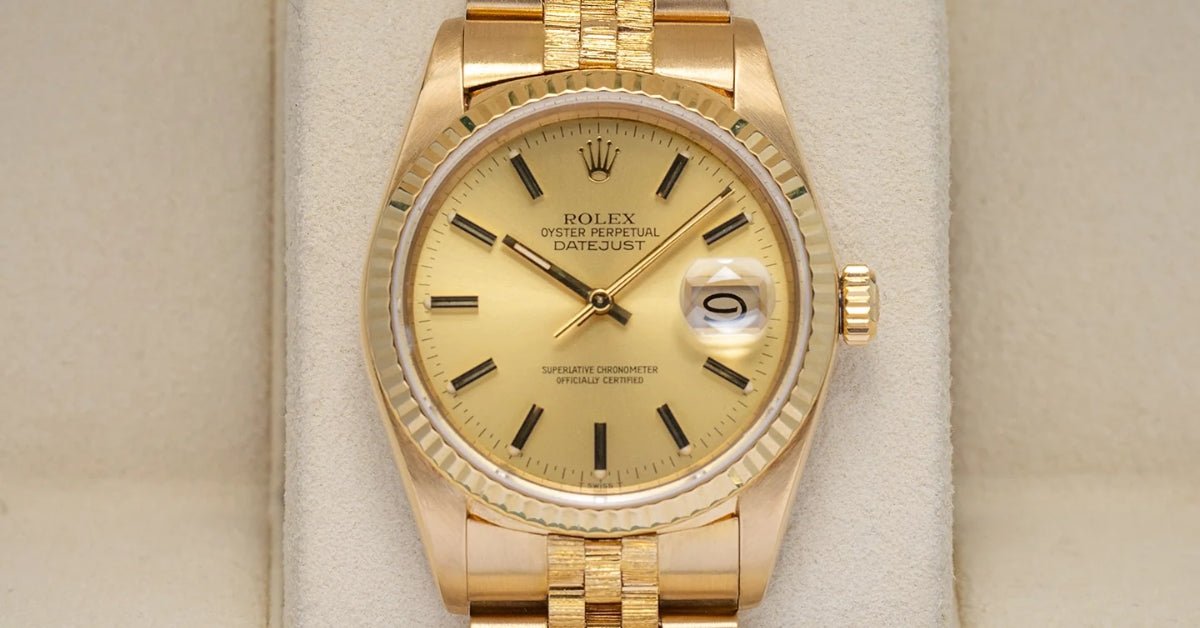
El 16078 es el Datejust Rolex más condecorado que jamás se haya fabricado. Oro amarillo macizo de 18k, 36 mm, y acabado en corteza — una textura de vetas de madera trabajada a mano aplicada al bisel y repetida a lo largo de los eslabones centrales del brazalete Jubilee. Los coleccionistas italianos lo llaman Corteccia. Rolex lo fabricó a finales de los setenta y ochenta, y luego dejó de ofrecer este acabado por completo.
Lo que significa que cada superficie con acabado de corteza en su reloj es una cantidad fija. Esto importa más de lo que parece, y es la razón por la que una correa hace algo en esta referencia que no hace en ningún otro Datejust.
Tamaño y ajuste de la correa para el Datejust 36 (16078)
El 16078 es una caja de 36 mm con un ancho de asas de 20 mm.
No hay talla que seleccionar en Helvetus — cada correa de la colección Datejust 36 está hecha para esta caja:
→ Todas las correas de caucho para el Rolex Datejust 36
Elija la versión con hebilla. Las correas con cierre desplegable están diseñadas para el moderno cierre desplegable de Rolex, y su 16078 venía con un cierre de oro de época. La hebilla incluye su propia hebilla de acero, se ajusta de todas formas y significa que un sólido cierre de oro de 18k nunca se volverá a manipular.
Cómo leer el número de referencia, ya que explica todo el reloj: en esta época, el último dígito es el metal — 8 es oro amarillo de 18k — y el dígito anterior es el bisel. Un 16018 es de oro con bisel estriado; su 16078 es de oro con acabado de corteza. Un solo dígito, y es la razón por la que los dos relojes no se parecen en nada.
Qué es el 16078
Caja Oyster de 36 mm de oro amarillo macizo de 18k, bisel de oro con acabado de corteza, eslabones centrales con acabado de corteza en un brazalete Jubilee de oro, calibre 3035 con fecha de ajuste rápido, resistencia al agua de 100 m. Las esferas eran de oro con números romanos negros, champán con índices de oro y la gama habitual más allá de eso.
Una cosa que debe comprobar usted mismo: los distribuidores describen el cristal de las referencias de oro de esta generación de forma inconsistente — algunos enumeran el zafiro, otros el acrílico. Las versiones de acero y bicolor de esta generación están bien establecidas como acrílicas, pero las de oro no están definidas, y cuarenta años de servicio han cambiado muchas en ambos sentidos. El acrílico se asienta abovedado, calienta la luz en el borde de la esfera y se raya con casi nada; el zafiro es más plano, refleja con más fuerza y se astilla en lugar de rayarse. Vale la pena saber cuál tiene, porque solo uno de ellos se puede pulir en casa.
Por qué una correa hace algo aquí que no hace en ningún otro lugar
Porque en el brazalete, la corteza deja de ser una textura y se convierte en papel tapiz.
Mire un 16078 con su brazalete original. El bisel es de corteza. Los eslabones centrales son de corteza, por ambos lados de su muñeca. El resultado es que el acabado más inusual que Rolex ha aplicado a un reloj se repite tantas veces que su ojo deja de registrarlo — se lee como una textura general, no como un detalle. Todo compite con todo.
Ahora quítese el brazalete. El bisel de corteza se convierte en la única superficie texturizada de todo el reloj: un anillo de oro trabajado a mano, enmarcado por una correa lisa y una esfera lisa, sin nada más que compita con él. Pasa de ser un panel de un patrón repetitivo a ser el punto central del reloj. En ningún otro Datejust la eliminación del brazalete cambia lo que realmente se nota de manera tan drástica.
Y aquí está la parte que importa comercialmente: la corteza es el único acabado que no se puede recuperar. Un bisel estriado se puede volver a pulir. Una superficie pulida se puede volver a pulir. La corteza está trabajada en el metal, y Rolex ya no ofrece este acabado — no está en la gama y no lo ha estado durante décadas. Un bisel de corteza o un juego de eslabones de corteza que se haya desgastado, deslustrado o sobrepulido no se puede renovar, y los ejemplos nítidos son cada vez más difíciles de encontrar cada año.
El bisel está en la caja, donde está relativamente seguro. La corteza del brazalete está en la parte inferior de su muñeca, chocando con escritorios, teclados y marcos de puertas todos los días. Esa es la parte que está desapareciendo silenciosamente, y es la parte que puede quitar en dos minutos.
Además, lo obvio. Un Jubilee de oro macizo con eslabones centrales con acabado de corteza es pesado, y el oro se valora sustancialmente por su masa — cada pulido elimina un poco de lo que pagó, de forma permanente.
Cuatro correas para el 16078 — todas deliberadamente lisas
Una nota antes de las elecciones: omita cualquier cosa con una raya o un patrón en esta referencia. Las correas LuxLine® son excelentes en relojes más sencillos, pero aquí una línea de color compite directamente con la corteza por la atención, y la corteza pierde. En un 16078, todo el trabajo de la correa es ser lo suficientemente discreta para que el bisel pueda hablar.
1. Negro — el que hace visible la corteza
La superficie más lisa que se puede poner bajo un bisel de oro texturizado, y la más eficaz. Contra el negro, la corteza capta la luz de una manera que simplemente no puede cuando está rodeada de más corteza, y la caja adquiere un borde duro que no tiene con un brazalete de oro completo.
Si compra una correa para este reloj, compre esta.
→ Correa de caucho negra para el Rolex Datejust 36
2. Marrón — la opción cálida y discreta
El marrón hace el mismo trabajo con menos contraste. Se mantiene fuera del camino, mantiene el reloj cálido en todo momento y permite que el oro y la textura sean los protagonistas sin la dureza gráfica que aporta el negro.
Esta es la elección para el día a día, y le sienta particularmente bien a la esfera de oro y números romanos negros.
→ Correa de caucho marrón para el Rolex Datejust 36
3. Beige — para las esferas champán
La respuesta tonal. El beige, una esfera champán y una caja de oro forman un objeto cálido continuo, con el bisel de corteza como única interrupción — que es precisamente donde se quiere que se detenga la mirada.
También es el más favorecedor de los cuatro en un reloj de 36 mm, y funciona con los marcadores de tritio envejecidos color crema.
→ Correa de caucho beige para el Rolex Datejust 36
4. Burdeos — el de noche
El rojo vino intenso bajo el oro amarillo es una combinación largamente establecida, y es lo suficientemente oscuro como para que la corteza sea lo más brillante y llamativo del reloj, añadiendo algo que el negro no hace.
Pida este si el 16078 es un reloj que usa para salir en lugar de para trabajar.
→ Correa de caucho burdeos para el Rolex Datejust 36
El resto de la gama está en la colección Datejust 36 — todo allí se ajusta a esta caja.
Misma caja, mismo ajuste de 20 mm
- 16018 — el mismo reloj de oro macizo con bisel estriado en lugar de corteza.
- 16013 / 16014 / 16030 / 16000 — las versiones bicolor, con bisel de oro blanco, guilloché y con bisel liso de esta generación.
- 1601 — el predecesor de cuatro dígitos.
- 116200 y 126200 — los Datejust 36 modernos. Siguen siendo de 20 mm.
- Day-Date 18078 — el mismo acabado de corteza aplicado al President. Colección diferente, brazalete diferente.
Respuestas rápidas
¿Qué ancho de asa tiene el Rolex Datejust 16078? 20 mm, en una caja de 36 mm.
¿Necesito seleccionar una talla? No. Todo en la colección Datejust 36 está hecho para esta caja.
¿Qué significa el 7 en 16078? Es el bisel. En esta generación el último dígito es el metal y el anterior es el tipo de bisel — 16018 es oro con bisel estriado, 16078 es oro con acabado de corteza.
¿Se puede restaurar un bisel de corteza? No en ningún sentido significativo. Rolex ya no ofrece este acabado, por lo que la corteza desgastada o sobrepulida no se puede renovar — que es precisamente por qué vale la pena mantener el brazalete de corteza fuera del uso diario.
Antes de ordenar
El 16078 es uno de los relojes más distintivos que Rolex ha fabricado y uno de los más fáciles de estropear, porque su característica definitoria es una textura que se desgasta y no se puede reemplazar. Una correa convierte el bisel de corteza en la estrella en lugar de una pieza de un patrón, y retira por completo el brazalete de corteza de la línea de fuego.
Las correas Helvetus para el Datejust 36 están cortadas para esta caja exacta, vienen con una garantía de por vida en el caucho, se envían gratis a todo el mundo sin costes de importación, y son usadas por más de 50.000 clientes. Primero el negro — verá el bisel correctamente por primera vez.