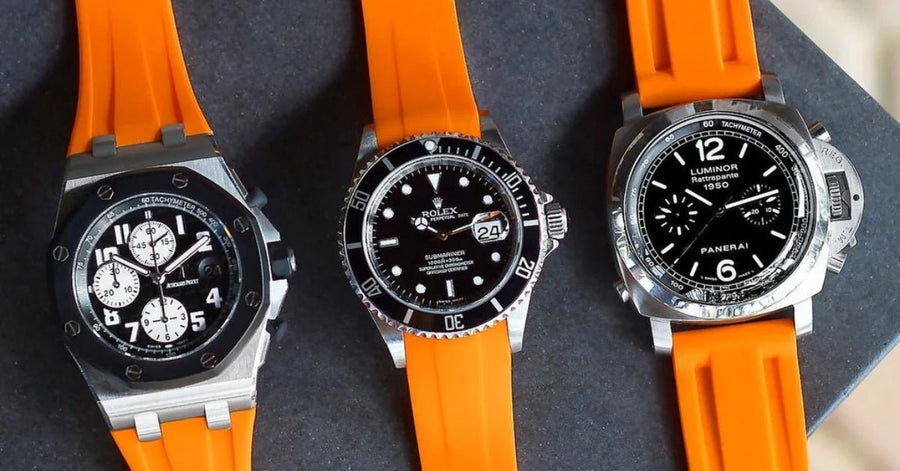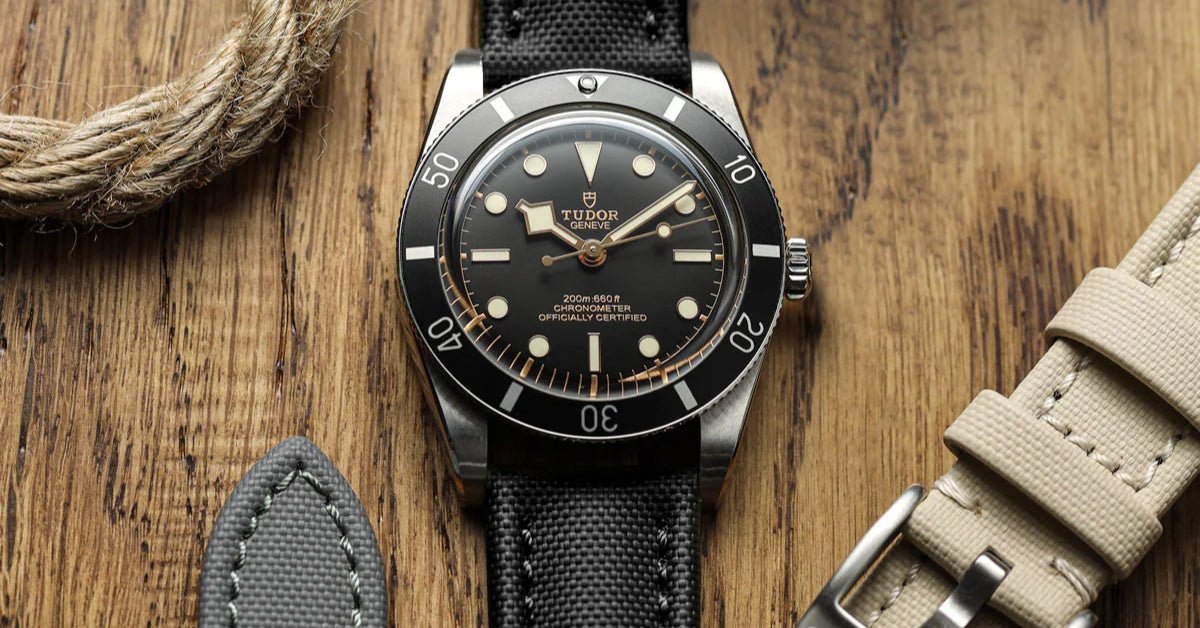
Sailcloth is the most under-discovered strap material in the modern aftermarket. Most collectors who own one or two leather and rubber straps haven't tried sailcloth, don't know quite what it is, and quietly assume it's just textured nylon. It isn't. Sailcloth has a distinct history, a distinct construction, and a distinct visual register that genuinely sits between leather and rubber rather than copying either.
It also has the best origin story of any modern strap material — one that runs through the French Navy, Jacques Cousteau, the invention of the modern dive watch, and a partnership between an active-service combat frogman and the CEO of one of the oldest watchmakers in the world. None of that is invented for marketing. It's documented horological history.
This guide covers what sailcloth straps actually are at the material level, where the category came from, the differences between real sailcloth and modern interpretations of it, what watches it suits, the practical pros and cons, and why so many serious collectors end up with at least one in their rotation.
Where Sailcloth Watch Straps Actually Came From
The category traces directly to one watch and one moment: the Blancpain Fifty Fathoms, introduced in 1953.
The story begins in 1952. The French Navy had recently formed an elite combat-diver unit (the Nageurs de Combat — "Combat Swimmers") under Captain Robert "Bob" Maloubier and Lieutenant Claude Riffaud. The unit was tasked with underwater reconnaissance and sabotage operations, and they needed a wristwatch they could rely on at depth. After testing every existing dive watch on the market and finding none of them adequate, Maloubier wrote a specification document for what the watch needed to do — high water resistance, a black dial with high-contrast luminous numerals, a unidirectional rotating bezel for tracking dive time, automatic winding, and antimagnetic shielding.
Maloubier and Riffaud took the spec to several Swiss watchmakers, most of whom turned them down. The exception was Jean-Jacques Fiechter, then CEO of Blancpain, who was himself an avid recreational diver and immediately understood what the unit needed. Working from Maloubier's specification, Fiechter and Blancpain produced the first Fifty Fathoms in 1953, named after the maximum dive depth recommended for SCUBA at the time (one fathom equals roughly 1.83 metres, so fifty fathoms equals approximately 91 metres). Many of the requirements Maloubier laid out in 1952 — black dial, rotating bezel, water resistance, magnetic resistance — went on to form the basis of ISO 6425, the international standard that now defines what a dive watch is.
Crucially for our subject, the Fifty Fathoms wasn't fitted with a steel bracelet or a leather strap. Both would have been wrong for combat diving — leather rotted, steel chafed and was noisy underwater. The original Fifty Fathoms was fitted with a textile-reinforced rubber-canvas hybrid (often referred to as a "tropic strap" in collector circles), and over the following decades the watch became associated with various heavy-duty fabric and woven textile straps that could survive saltwater, sun, and military use. When the Fifty Fathoms returned in its modern form in 2003 to mark the 50th anniversary, Blancpain made canvas/sailcloth straps a signature option alongside the steel bracelet — a deliberate nod to the watch's military-marine heritage.
The Fifty Fathoms became the textbook reference for what a sailcloth strap should look and feel like on a serious dive watch, and the aftermarket category developed from there. Today, "sailcloth" as a strap term covers a range of woven technical fabrics that share a visual heritage with the Fifty Fathoms tradition, even when they're not made from actual yacht sail material.
What Sailcloth Strap Material Actually Is
Here's where most articles get vague. The term "sailcloth" suggests the strap is made from real boat sails. A few high-end specialist makers (Avel & Men in Brittany, for example) genuinely cut their straps from regatta sail offcuts containing Kevlar and carbon fibre wefts. Most aftermarket sailcloth straps, however, are made from purpose-woven technical fabrics that mimic the look and weave of yacht sail canvas without being the same material.
The common materials used in modern sailcloth straps:
Woven technical nylon. The most common material. High-strength nylon woven in a tight cross-pattern that mimics the look of traditional dacron sail canvas. Water-resistant, fast-drying, durable.
Recycled PET (polyester) weave. Increasingly common in modern brands, often marketed as eco-friendly. Visually almost identical to nylon sailcloth, slightly softer feel.
Cotton-canvas blends. Less common in modern aftermarket, more common on heritage-focused straps. Softer, more vintage-feeling, less water-resistant than synthetic equivalents.
Real regatta sailcloth. Cut from actual yacht sail material, sometimes with visible Kevlar or carbon fibre wefts. The most expensive and most authentic, but also the stiffest and most rigid — the same properties that make sails work also make them unforgiving as wrist material.
FKM rubber with sailcloth pattern (hybrids). Some modern brands (notably Artem and Delugs) mould FKM rubber with a textured pattern that visually replicates sailcloth weave but with rubber's durability and water resistance. Technically rubber, visually sailcloth.
The pattern matters as much as the material. The classic sailcloth weave — small visible cross-hatch with a slight ribbed texture — is the visual signature of the category. Whether achieved through actual woven fibre or moulded rubber pattern, that weave is what makes the strap read as "sailcloth" rather than as plain nylon or rubber.
Helvetus's MarinerTex sailcloth strap collection uses a high-density technical weave with a leather backing — the construction approach most collectors prefer because it gives you the technical look on the show side and leather comfort on the skin side.
The Construction That Separates Good Sailcloth From Cheap Sailcloth
Visually, two sailcloth straps can look almost identical. Functionally, they can be very different. The differences come down to four things.
1. The weave density. Premium sailcloth straps use tightly-woven fabric with a visible but compact pattern. Cheap sailcloth uses a looser, lower-thread-count weave that frays at the spring-bar holes and around the buckle within months. If you can see individual threads from arm's length, the weave is too loose.
2. The lining. This is the single biggest quality differentiator. The best sailcloth straps have a leather lining (calfskin, sometimes lined with a microfibre comfort layer) on the wrist side. This solves three problems at once: comfort against the skin (raw woven fabric can feel scratchy), structural rigidity (the lining holds the strap's shape), and durability (the strap can't fray on the wrist side because it's not exposed). Cheap sailcloth straps have either no lining or a thin synthetic backing that wears through within a year.
3. The edges. Good sailcloth straps have heat-sealed or stitched edges that prevent fraying. Cheaper ones have raw cut edges that start fraying immediately. Hand-stitched edges with contrast thread are a strong sign of quality construction.
4. The hardware. Welded-knob quick-release spring bars, properly tempered springs, and 316L stainless steel buckles are signs the maker takes the whole strap seriously. If they've cut corners on the spring bars, they've usually cut corners elsewhere too.
A well-made sailcloth strap will last 4–7+ years of regular wear. A cheap one will fray and look tired within 12 months. The difference is mostly in these four factors and not in the visible top fabric.
Where Sailcloth Sits Between Leather and Rubber
The unique selling point of sailcloth — the thing it does that no other material does as well — is that it genuinely transitions across registers. A sailcloth strap on a dive watch looks at home both at the marina and under a blazer. That's a narrower trick than you might expect. Most strap materials commit fully to a register: leather is dressy, rubber is sporty, NATO is casual-military. Sailcloth genuinely splits the difference.
Side-by-side with leather, sailcloth is more weather-tolerant (handles rain, sweat, light water exposure) but slightly less dressy. Side-by-side with rubber, sailcloth is less aggressively sporty (it doesn't shout "tool watch" the way thick FKM does) but it's not as fully waterproof for serious water exposure.
The result is a strap material that suits a specific cluster of watches especially well: dive watches with crossover potential, GMTs, sport-luxury chronographs, and pilot watches. These are watches that genuinely live in both worlds, and sailcloth is the strap that goes both places without complaining.
What Sailcloth Suits — And What It Doesn't
The watches sailcloth works best on:
Dive watches with dressy potential. Blancpain Fifty Fathoms (the textbook pairing), Tudor Black Bay, Omega Seamaster Diver 300M, Rolex Submariner, Tudor Pelagos, Panerai Luminor, IWC Aquatimer. The marine heritage is part of why the strap looks right.
GMTs and travel watches. Rolex GMT-Master II, Tudor Black Bay GMT, Omega Seamaster Aqua Terra GMT, Grand Seiko GMT references. The technical look pairs well with the function.
Chronographs with sporting heritage. Omega Speedmaster, Rolex Daytona (sparingly — most Daytona owners stay rubber or bracelet), Breitling Navitimer, Tag Heuer Carrera, Zenith El Primero. Sailcloth gives a chronograph a boat-deck feel.
Field and pilot watches. IWC Pilot, IWC Big Pilot, Bremont, Sinn — the rugged-utility register suits sailcloth particularly well.
Steel-and-ceramic sport-luxury watches. Anything from Hublot Big Bang (paired carefully) to Bell & Ross BR03 takes sailcloth well in the right colourway.
What sailcloth doesn't suit:
Formal dress watches. A Patek Calatrava, Vacheron Patrimony, or Lange Saxonia on sailcloth is wrong — the woven texture clashes with the formal register. These watches need leather, alligator, or fabric only as deliberate countercultural statement.
Rectangular dress watches. Cartier Tank, Tank Louis, JLC Reverso, Hamilton Ventura — the geometric formality of these cases doesn't match the technical look of sailcloth.
Vintage-style Cartier. Tank, Santos, Ballon Bleu, Ronde — the Cartier register is fundamentally smooth and refined, and sailcloth's military-marine character clashes.
Watches that genuinely live in water. For serious dive use, FKM rubber is technically better than sailcloth — it's fully waterproof, doesn't absorb water at all, and dries instantly. Sailcloth is water-resistant rather than waterproof. If your watch genuinely sees deep water regularly (not occasional swims), choose rubber.
Practical Pros and Cons
Pros:
The texture is distinctive. Up close, no other material looks like sailcloth — the weave pattern is instantly recognisable.
It's lighter than rubber and almost as light as a thin leather strap. On a heavy dive watch, the weight reduction matters.
It transitions well between formal and casual. Few materials genuinely do this.
It dries fast. After light water exposure, a quality sailcloth strap is dry within 30–60 minutes — much faster than leather, slower than FKM rubber.
It pairs well with most colours and case finishes. Navy, charcoal, beige, black, olive, brown — sailcloth holds colour well and looks right with both steel and gold cases.
It's relatively affordable. A premium sailcloth strap usually costs 20–40% less than equivalent-quality alligator and roughly the same as good calfskin.
Cons:
It's not fully waterproof. Sailcloth absorbs a small amount of water during prolonged immersion. For pool, ocean, or shower use, FKM is better.
Cheaper versions fray. The category has a wider quality range than rubber or leather — there's plenty of bad sailcloth out there. Pay for quality.
It's slightly less comfortable on day one than leather. The fabric is firmer and takes a few wears to soften and conform to the wrist.
It's not a true dress strap. If you wear formal watches in genuinely formal settings, sailcloth isn't the right material — you need alligator or calf.
Frequently Asked Questions
Are sailcloth watch straps actually made from sails? Mostly no. A few specialist makers cut their straps from real regatta sailcloth, but most aftermarket sailcloth straps are made from purpose-woven technical nylon or polyester that mimics the look of yacht sail canvas. The material isn't fake — it's just engineered for the application rather than repurposed from boats.
Are sailcloth straps waterproof? Water-resistant rather than fully waterproof. They tolerate rain, sweat, and brief water contact (rinsing under a tap) without damage. For serious water exposure — diving, swimming laps, regular shower wear — FKM rubber is the better choice. For everyday wear including occasional weather and brief water contact, sailcloth is fine.
How do I clean a sailcloth strap? Wipe with a damp cloth and mild soap, gently scrub stubborn spots with a soft toothbrush, rinse with clean water, pat dry with a towel, and air dry at room temperature out of direct sunlight. Don't soak the strap, don't put it in a washing machine, and don't use solvents or alcohol — the fabric and the leather lining have different chemical tolerances and what's safe for one isn't always safe for the other.
How long should a sailcloth strap last? A quality sailcloth strap (tight weave, leather lining, sealed edges) lasts 4–7+ years of regular wear. A cheaper sailcloth without proper construction can fray and look tired within 12 months. The difference is mostly in construction, not in the visible top material.
Will sailcloth fade in the sun? Quality dyed sailcloth resists UV well — the colour stays consistent for years of daily wear. Cheaper dyed fabrics fade faster, particularly in lighter colours. Black, charcoal, and dark navy hold colour longest. Beige, white, and bright colours show fading sooner.
Can I wear a sailcloth strap with a suit? With caveats. A dark sailcloth (black, charcoal, navy) on a dive watch or chronograph paired with a relaxed suit (single-breasted, contemporary cut) absolutely works — it's part of the strap's appeal. With formal suits, black tie, or genuinely conservative dressing, alligator or calf is a better choice.
Is sailcloth comfortable for long wear? A leather-lined sailcloth strap is genuinely comfortable for all-day wear. A raw, unlined sailcloth strap can feel slightly scratchy against the skin and isn't great for hot weather. Always choose lined sailcloth for daily wear.
What's the difference between sailcloth and canvas straps? A lot of overlap, with one main distinction. Canvas is generally cotton-based, softer, more matte, and has more vintage/military character. Sailcloth is generally synthetic-based, technical, with a more pronounced weave pattern and a slight sheen. Both are woven fabrics, but they look and feel different in the hand.
The Bottom Line
Sailcloth is the most underrated strap material in the modern aftermarket. It does something no other material does as well — it transitions credibly between formal and casual, between marina and meeting room, between sport watch and dress-casual register. The story behind it is genuine and unusually rich — French Combat Frogmen, Jean-Jacques Fiechter, the invention of the modern dive watch, and seven decades of association with the Blancpain Fifty Fathoms.
If you don't currently own a sailcloth strap, it's the easiest gap to fill in a strap rotation. It pairs especially well with dive watches, GMTs, chronographs, and any sport-luxury piece that already lives somewhere between formal and casual. Pay for quality — leather lining, tight weave, sealed edges, quality spring bars — and a sailcloth strap will last 5+ years and look better as it breaks in.
Helvetus's MarinerTex sailcloth strap collection is built with a high-density technical weave on the show side and full calfskin leather on the lining, with quick-release spring bars and brushed stainless steel hardware. Available in widths and end-fits for over 25 luxury watch brands.
Most of our customers wear Rolex or Cartier — both work with sailcloth in the right configuration. The Rolex strap collection includes sailcloth options that pair particularly well with the Submariner, GMT-Master II, Yacht-Master, and sport-watch references where the marine heritage is part of the appeal. The Cartier strap collection covers the Santos and other Cartier sport models where sailcloth works (the Tank family is better in alligator or calf — see the materials guide for that distinction). For the rest of the rotation, our curved FKM rubber and calfskin leather collections complete the sport-and-dress coverage. Browse the full range at helvetus.com, use our Strap Finder to match the right strap to your watch reference, or read more on the Helvetus blog.