When the Audemars Piguet × Swatch Royal Pop went on sale on May 16, the scenes outside boutiques looked less like a watch launch and more like a ticket queue for a stadium tour. Two weeks later, the crowds have gone home, the videos have stopped trending, and a calmer question has taken their place: was any of it actually a success — and for whom?
It is a harder question than it sounds, because "success" means something different to each party in the room. For Swatch, success is foot traffic and relevance. For Audemars Piguet, it is reaching a generation that has never set foot in a Le Brassus boutique. For the thousands who queued, it was either a watch to keep or a watch to flip. So we did what we do best at Helvetus: we ignored the noise and went to the data. Here is what the first two weeks actually say.
A quick recap, for anyone just tuning in
The Royal Pop is a collection of eight Bioceramic pocket watches that reinterpret AP's Royal Oak — the octagonal bezel, the eight hexagonal screws, the Petite Tapisserie dial — in the modular, clip-out spirit of Swatch's 1986 Pop line. Each one runs a brand-new hand-wound version of Swatch's SISTEM51 movement (15 active patents, 90-plus hours of power reserve, a Nivachron balance spring), visible through a printed sapphire caseback. The case head is 40 mm, 8.4 mm thick, and arrives on a calfskin lanyard rather than a wrist strap.
Retail sat at roughly $400 (around €385–€400, or £335–£350 depending on style and market), one watch per person, per store, per day, boutique-only, no online sales. The eight references — Huit Blanc, OTG Roz, Otto Rosso, Ocho Negro, Orenji Hachi, Green Eight, Blaue Acht and Lan Ba — nod to the Royal Oak's eight-sided case. And in a detail that has gone underreported, Audemars Piguet pledged 100% of its proceeds to a fund supporting endangered watchmaking crafts and scholarships for the next generation of watchmakers.
The launch itself: chaos as a metric
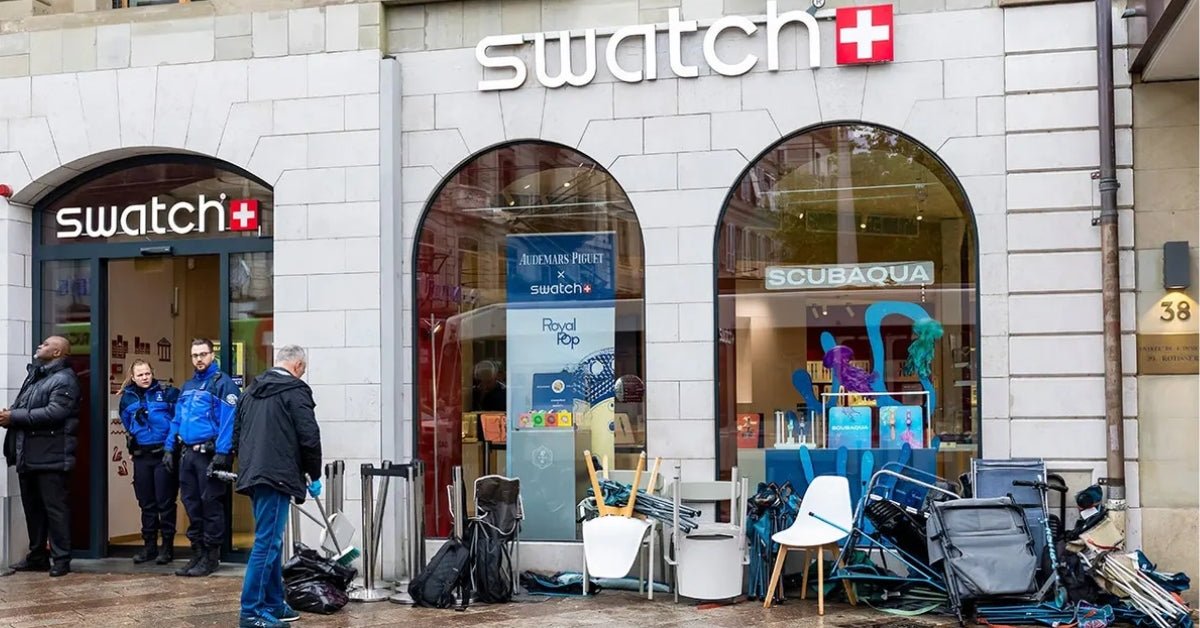
Let's not pretend the opening weekend was smooth. As CNN reported, lines formed from Paris to Kuala Lumpur, fights broke out, security struggled, 19 outlets in the US were closed over safety concerns, a police officer on Long Island appeared to pepper-spray a crowd, and arrests were reported on both sides of the Atlantic. Launch events in India and Dubai were cancelled before they began. Swatch issued a public plea asking people "not to rush to our stores in large numbers."
Swatch Group CEO Nick Hayek was unrepentant, framing the launch on BBC Radio 4 as a "good news story" and pointing out that of roughly 220 stores worldwide, only about 20 — around 10% — saw real trouble. You can read that as spin, or you can read it the way the market did: a product so wanted that police had to manage the demand is not a product that failed to land. Chaos, uncomfortable as it was, is the loudest possible signal of desire.
The resale market: cooling, not crashing
This is where most of the "is it a flop now?" chatter lives, so it deserves real numbers rather than vibes.
On launch weekend, listings on Chrono24 ran from roughly $1,200 to nearly $6,000, with one analysis clocking the blue Lan Ba peaking around $6,547 before a single piece had reached its first owner. Chrono24's own transaction data put the average completed sale at about €1,440 in those first days, with half of all sales landing between €1,200 and €1,400.
Then gravity arrived. According to WatchPro's daily price tracking, here is where the secondary market stood roughly ten days in, versus its day-after-launch peak:
| Platform | ~May 26 average | Day-after-launch peak | Change |
|---|---|---|---|
| eBay (sold) | ~$1,610 | ~$2,250 | ▼ ~28% |
| Chrono24 (asking) | ~$2,330 | ~$2,750 | ▼ ~15% |
| StockX (transactions) | ~$1,720 | ~$1,950 | ▼ ~12% |
A 12–28% pullback in under two weeks reads dramatic in a headline. In context, it is exactly what a healthy market does after a launch-day spike — and it still leaves the average piece changing hands at roughly four to five times retail. The rainbow-accented Huit Blanc has emerged as the collection's hero, trading around $1,950–$2,100, while the light-blue Lan Ba anchors the floor near $1,400.
The crucial point most coverage misses: the Royal Pop was never a limited edition. Like the MoonSwatch in 2022 and the Blancpain × Swatch before it, it is built on continuous production. The only true scarcity was launch-day access. As supply trickles back into stores, the premium narrows — which is the design working as intended, not the hype collapsing. For reference, the MoonSwatch opened near $2,400 on the resale market and settled to roughly $400–$700 over the following months. If precedent holds, expect the Royal Pop to keep softening across a 30-to-90-day window.
Verdict on resale: the easy flip is over, but a watch holding 4–5x its sticker two weeks in is not a market that has rejected the product. It's a market normalizing.
Swatch's scoreboard: this is the clearest win
If the Royal Pop has an unambiguous victor, it is Swatch Group. The company entered 2026 bruised — full-year 2025 revenue around CHF 6.28 billion, down nearly 7%, with earnings effectively wiped out and the share price having touched a 52-week low of CHF 127.05.
Then came the collaboration. Shares jumped 4.4% to CHF 210.60 on the May 8 announcement, and by the time the dust settled around launch they were up roughly 15% over two weeks. As of late May, the stock is trading near CHF 212 — within touching distance of its 52-week high of CHF 213.80, and up about two-thirds from that February low. One viral pocket watch did what quarters of strategy had not: it put Swatch back in the headlines for the right reasons.
And the hype was, by one measure, bigger than the MoonSwatch's. Chrono24 reported daily requests on launch weekend running 2.9 times higher for the Royal Pop than for the MoonSwatch in March 2022 — making this, arguably, the most attention-grabbing watch launch of the decade so far.
Audemars Piguet's scoreboard: a win on reach, a verdict deferred on brand
This is the genuinely interesting one, and the part other outlets keep getting lazy about.
On pure reach, the numbers are staggering. CEO Ilaria Resta told Bloomberg Television that AP's website drew more than ten times its usual annual traffic in a single day. To put the scale gap in perspective: Audemars Piguet produces an estimated 50,000 watches a year; the Swatch brand makes around 4.4 million. The Royal Pop handed AP a megaphone it could never buy.
There are even early signs of a halo on the real thing: Chrono24 noted demand for Royal Oaks rising around 40% in the launch week. The caveat — and it matters — is that data house EveryWatch showed Royal Oak dealer prices spiking on the news and then settling straight back to their longer-term trend. So far, that reads as a spike in attention, not a durable shift in value.
Against all that sits the brand-dilution worry that has lit up watch forums. The sharpest version of the argument: once a buyer associates AP with a $400 object, a $40,000 Royal Oak starts to feel absurd — and the more successful the collaboration, the stronger that association becomes. Resta's framing is the counterargument. She positioned this as a "one-off collaboration" with a singular aim — to ignite collective desire — and leaned on a bigger mission, telling reporters that "Nobody needs a watch to tell the time" and that the industry's craft is worth preserving. Hence the 100%-of-proceeds pledge, framed explicitly against the memory of the quartz crisis that erased two-thirds of the industry.
Verdict on AP: a marketing triumph and a reputational gamble running in parallel. The win is already booked; the cost, if there is one, won't show up on a chart for months. There's a reason one resale-market analysis called the whole thing a study in good instincts and uncertain timing.
The Royal Pop "success scorecard"
If you take one thing from this piece — or quote one thing — make it this snapshot of the first two weeks:
- Hype: ~2.9× higher daily Chrono24 requests than the MoonSwatch at launch.
- Reach: AP website traffic up ~10× its normal annual volume in a single day.
- Resale: still ~4–5× retail, after a ~12–28% cool-down from peak.
- Hero model: Huit Blanc (~$1,950–$2,100). Floor: Lan Ba (~$1,400).
- Stock: Swatch Group near a 52-week high (~CHF 212), up ~15% across the launch window.
- Halo: Royal Oak demand up ~40% in launch week — but real-world prices reverted to trend.
- New blood: the majority of Royal Pop buyers on Chrono24 were new to the platform — the same first-buyer surge the MoonSwatch produced.
That last number may be the most important of all. Collaborations like this don't just sell the launch model; they pull first-time buyers into the hobby, and some of those buyers stay for life. Many of us in watches started with a Casio, a fake, or a Swatch. The Royal Pop is simply the 2026 version of that doorway.
The one box the Royal Pop forgot to tick: your wrist
Here is the practical gap nobody at the design stage solved. The Royal Pop is a Royal Oak silhouette — the most iconic sport-luxury case ever drawn — delivered as a pocket watch on a lanyard. Owners clipped it to a bag, hung it round the neck (the inevitable Labubu comparisons wrote themselves), and then asked the obvious question: how do I actually wear this thing the way a Royal Oak is meant to be worn?
That question has become a cottage industry, and it's where we live. Helvetus has engineered aftermarket straps for the real Audemars Piguet Royal Oak family for years — Royal Oak 39, 41, Offshore 42 and 44, and the Offshore Diver — so building a Royal Pop strap-and-case kit that pops the 40 mm head out of its chassis and onto the wrist in seconds was a natural extension of work we already do daily. It's cut from the same FKM rubber compound that runs through our Rolex strap range — the same material family Rolex uses on the Oysterflex — and our Cartier collection, for everyone whose Tank or Santos wants a summer rotation. The point isn't the sale. The point is that the Royal Pop's biggest limitation is also the clearest evidence of how much people want to wear it.
So — success or not?
Two weeks of data give a clear, layered answer.
By attention and reach, the Royal Pop is a runaway success — most likely the most successful Swatch collaboration to date, and a genuine lifeline for Swatch Group's share price and cultural relevance.
By the flipper's math, the gold rush is over. Prices are normalizing toward the long, slow MoonSwatch curve, and anyone who bought at peak to resell missed the window.
And for Audemars Piguet, the jury is genuinely still out — a marketing masterstroke whose long-term effect on a $40,000 brand simply cannot be measured yet.
What isn't in doubt is the demand. The crowds were real, the resale floor is still multiples of retail, and the watch world hasn't talked this much about a single launch in years. Whether the Royal Pop ages into an icon or a curiosity, one thing is already certain: it changed the conversation. The only thing left to change is where you wear it.
Helvetus is an independent strap maker and is not affiliated with, endorsed by, or sponsored by Audemars Piguet or Swatch AG. All trademarks are referenced for descriptive and compatibility purposes only. Resale figures cited are drawn from publicly reported marketplace data and represent a moment in a fast-moving market.