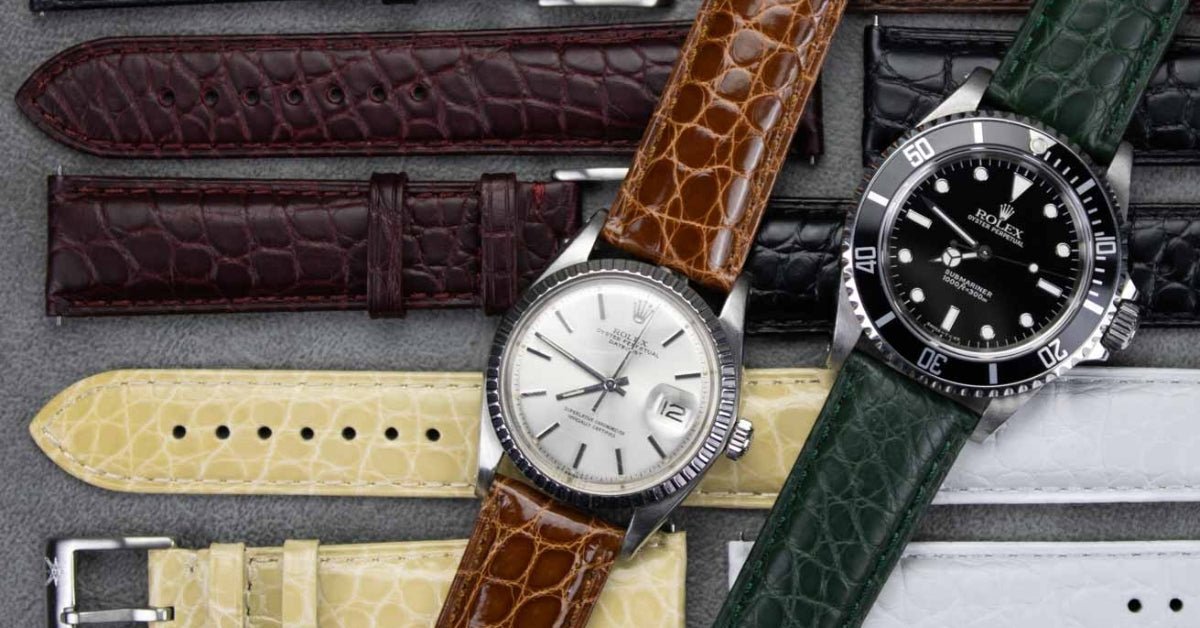
If you've shopped for a high-end leather watch strap, you've come across both terms — alligator and crocodile — and possibly wondered whether they're the same thing in different marketing copy. They're not. They come from different animals, they look different up close, they cost different amounts, and one of them is what virtually every top-tier watchmaker uses on their dress watches. Knowing which is which protects you from overpaying, getting the wrong texture for your watch, or buying something that turns out to be embossed calfskin pretending to be reptile.
This guide covers what alligator and crocodile leather actually are at the species level, how to tell them apart visually, why one costs more than the other, how to spot embossed fakes, what CITES regulations mean for travelling and importing these straps, and which one belongs on your specific watch. There are no marketing platitudes here — just the facts a serious buyer needs.
They're Two Different Animals (And Not All Crocodiles Are Equal)
The first piece of confusion to clear up: alligator and crocodile aren't styles of leather. They're different species in the same biological order (Crocodilia), and beyond that, "crocodile leather" itself covers several very different species with very different qualities and price points.
American alligator (Alligator mississippiensis). The species used for almost every high-end alligator watch strap on the market. Native to the southeastern United States — Louisiana, Florida, Texas, Mississippi — and farmed sustainably under strict CITES regulation. The leather has a distinctive square scale pattern on the belly, smaller scales on the flanks, and crucially, no integumentary sensory organ pore in the centre of each scale (more on that in a moment). This is what Patek Philippe, Vacheron Constantin, A. Lange & Söhne, Audemars Piguet and most other top-tier watchmakers use on their dress watches.
Nile crocodile (Crocodylus niloticus). Found in Africa, farmed in countries including Zimbabwe, South Africa, and Kenya. The leather has clear sensory pores in the centre of each scale — a small dot you can see and feel. Generally considered the highest-grade crocodile, used by Hermès, Louis Vuitton, and many luxury houses. Slightly stiffer than alligator with a more pronounced scale pattern.
Saltwater crocodile (Crocodylus porosus). Native to Southeast Asia and Northern Australia. Farmed in Australia (largely) and used widely in Hermès, LVMH, and Italian leather goods. Often considered equivalent to or slightly above Nile crocodile in luxury hierarchy.
Siamese crocodile (Crocodylus siamensis). Farmed extensively in Thailand and Vietnam. The most common "crocodile" leather you'll find on mid-tier watch straps. Distinctively larger flank scales than Nile crocodile, with prominent ridge scales along the side that strap makers generally cut around because they're hard to stitch through.
Caiman (Caiman crocodilus, Caiman crocodilus fuscus). Found in Central and South America. The cheapest of the crocodilians used in leather. Caiman skin is notoriously high in calcium content, which makes it stiffer, rougher, and harder to work with. It's used on entry-level "crocodile" products and almost never on serious watch straps.
When a strap is sold as "alligator," it should be American alligator — there's effectively no other commercial alligator species. When a strap is sold as "crocodile," that single word covers a four-tier hierarchy from caiman at the bottom to Nile and saltwater croc at the top. A reputable seller will tell you which species their crocodile actually is. If they won't, that's information.
The Visual Difference: How to Tell Alligator From Crocodile
This is the question most buyers care about, and most articles online get it partly wrong. The defining difference isn't scale shape — both alligator and crocodile can have square scales (from the belly) or rounder scales (from the flanks). The reliable difference is the integumentary sensory organ pore, often called the ISO pore.
Crocodiles have small sensory hairs on the surface of each scale in life. These hairs are removed during tanning, but the pore where each hair sat remains visible as a tiny dot in the centre of each scale. Alligators don't have these sensory pores. Their scales are smooth in the centre.
So the test is simple: if there's a small visible pore or dot in the centre of each scale, it's crocodile. If the scales are smooth in the centre, it's alligator.
Beyond the ISO pore, a few other tells:
Scale uniformity. Alligator belly scales (the premium cut) are large, square, and arranged in clean rows with subtle natural variation. Crocodile scales tend to be slightly less uniform with more visible irregularity from scale to scale.
The umbilical scar. Both alligator and crocodile have an umbilical scar somewhere on the belly hide — the natural mark where the animal's umbilical cord was attached. On premium straps cut from large hides, the strap is positioned to avoid this scar; on less premium cuts you can sometimes see it.
Sheen and finish. Tanned alligator typically has a slightly more uniform, refined sheen out of the box. Crocodile can be slightly more matte or have a slightly more textured finish depending on the tannery.
Stiffness on day one. Crocodile is usually slightly stiffer initially. Both soften with wear, but alligator breaks in faster.
If the seller can't or won't show you a close-up photo of the scales, walk away. If they show you a photo and you don't see ISO pores but they're calling it crocodile, it's probably actually alligator (good news, that's an upgrade) or it's embossed calfskin (bad news, that's a downgrade — see the fakes section below).
Belly, Flank, Tail, Hornback: Why the Cut Matters as Much as the Species
Within both alligator and crocodile, the cut of the hide changes the entire character of the strap. The same animal can produce four very different strap styles depending on where the leather is taken from.
Belly. The premium cut. The skin from the underside of the animal has the largest, most uniform, and most symmetrical scales. Belly cuts have the famous square-scale pattern most associated with high-end exotic straps and are used for nearly all luxury dress-watch straps. About 85% of an exotic crocodilian's commercial value comes from the belly.
Flank/side. The skin from the sides has smaller, rounder scales than the belly. Less uniform, less expensive, but still genuine exotic leather. Often used for less expensive exotic straps where the round-scale look is desirable, or for smaller items like wallet panels.
Tail. Smaller scales, sometimes ridged, less commonly used for watch straps. Often ends up in cheaper accessories.
Hornback. The skin from the back of the animal, with prominent raised ridge scales along the spine. Very distinctive looking — almost armoured. Used occasionally for statement straps and accessories. Difficult to work with because of the irregular thickness.
When a strap is sold as "alligator belly" (or "Mississippiensis belly," same thing), you're getting the premium cut. When it's sold simply as "alligator" or "crocodile" without the cut specified, it could be any part of the hide. For a luxury dress watch, belly is what you want.
Helvetus's alligator strap collection is cut from full American alligator belly hides — the same cut used by the top-tier dress watchmakers — and hand-finished in both square-scale (centre belly) and round-scale (flank) configurations.
The Real Pricing Hierarchy
Asking "is alligator better than crocodile" is the wrong question. The right question is "which species, which cut, what tannery, what construction?" Here's the rough hierarchy:
Top tier (£300+ for a watch strap): American alligator belly, French or Italian tannery, hand-finished. This is what comes on a Patek Calatrava or a Vacheron Patrimony from new. Tannage by Hermès Tanneries (HCP), Tanneries Roux, Pellesta, and similar.
Upper-mid (£150–£300): Quality alligator (American Mississippiensis) or Nile crocodile belly, generally European tannery, machine-finished but properly stitched. This is the sweet spot for most aftermarket buyers — genuine exotic leather, properly cut, lined, and edged, without the markup of OEM watchmaker pricing.
Mid (£60–£150): Often "crocodile" without species disclosure (likely Siamese), or alligator from less prestigious tanneries. Real exotic leather but you should expect less consistent scale matching, machine-folded edges, and less premium lining.
Entry "exotic" (£20–£60): Usually caiman or — far more commonly — embossed calfskin pretending to be reptile. At this price point, suspect a fake unless the seller provides genuine paperwork.
The premium for genuine American alligator belly over Siamese crocodile is usually 50–150% — a real and meaningful gap. The premium for either real exotic over embossed calfskin can be 5–10x. Knowing what you're paying for matters.
How to Spot Embossed Calfskin Pretending to Be Reptile
This is where most "alligator" and "crocodile" straps in the entry price tier actually live: stamped or embossed calfskin where a scale pattern has been pressed into ordinary cowhide. Modern embossing is good enough to fool someone seeing the strap from a metre away. Up close, the differences are clear if you know what to look for.
The depth-of-cut test. Genuine exotic leather has scales that are physically separate from each other — the leather isn't one continuous surface but a series of slightly raised plates with natural valleys between them. If you bend a real alligator strap hard, the individual scales lift slightly along their edges. Embossed calfskin is a continuous flat surface with a pattern pressed into it; it doesn't lift at the scale edges no matter how you bend it.
The pattern repetition test. Embossing uses a metal die that's pressed onto the leather. The same die produces the same pattern repeatedly, so embossed straps often have visible repetition — the same scale shape and size appearing in regular intervals. Genuine exotic has natural irregularity. No two scales are identical, and the pattern flows organically rather than tiling.
The edge test. On embossed calfskin, the pattern fades or stops at the cut edge of the strap because the embossing only goes so deep. On genuine exotic, the scale structure goes through the full thickness of the leather and the cut edge shows the same scale layers as the surface.
The price test. A genuine American alligator strap retails for at minimum around £100–£150 even at lower tiers, and authentic Nile or saltwater crocodile is similar. A "genuine alligator" strap selling for £25 on a marketplace site is almost always embossed calfskin or, occasionally, caiman labelled as alligator.
The certificate test. Reputable sellers of genuine exotic provide CITES documentation (more on this below). If a strap is sold as alligator or crocodile with no source documentation and no CITES paperwork, it probably isn't.
Embossed calfskin isn't bad — Helvetus and most other premium brands offer embossed calf options as an honest mid-tier choice that gives you the look of exotic at a calf-leather price. The problem is when it's sold dishonestly as genuine reptile, which sets up false expectations and dramatically overcharges for what it actually is.
The CITES Regulations You Need to Know About
This is genuinely useful information that most strap articles skip entirely. American alligator, Nile crocodile, saltwater crocodile, and most other commercial crocodilian species are listed under CITES (the Convention on International Trade in Endangered Species), the international treaty that regulates the trade of protected wildlife.
In practice, this means three things for watch buyers.
1. Legitimate sellers have paperwork. Reputable strap makers source their hides from licensed tanneries that issue CITES certificates documenting the species, the source farm, and the legal export status. Premium straps often arrive with a CITES tag or accompanying documentation. If they don't, ask. A seller that can't produce species and source documentation is selling either embossed leather or unlicensed material.
2. Cross-border shipping can be complicated. Sending a CITES-listed exotic strap across borders without proper paperwork can result in customs seizure or fines. There are documented cases where Swiss customs have intercepted alligator strap shipments and physically cut the strap off the watch before forwarding the watch on. This is why most premium aftermarket strap brands ship internationally with the CITES paperwork attached, and why some sellers simply won't ship exotic straps to certain countries. Always check the seller's shipping policy if you're buying from abroad.
3. Travelling with the strap on the watch is generally fine. The CITES exemption for personal effects allows travellers to wear an exotic strap across most international borders without paperwork, so long as the strap is part of the watch on your wrist (and not, say, three loose alligator straps in your luggage). The exemption typically covers up to 4 specimens of crocodilian leather goods in personal possession, but rules vary by country and you should verify before travelling internationally with high-value exotic items.
The key takeaway: legitimate exotic straps come with documentation. Sellers that won't provide it are usually a problem — either dishonest about what the leather is, or sourcing from outside the legal supply chain.
Which One Belongs on Your Watch?
Both alligator and crocodile work on the same range of watches. The question is more about your priorities than about the watch itself.
Choose alligator (specifically American alligator belly) if:
- You want the textbook luxury dress-watch leather, what Patek and Vacheron put on their watches from new.
- You want softer, slightly more pliable leather that breaks in faster.
- You want clean, uniform square scales without the visible pore dots.
- You're matching a specific OEM look (most luxury watchmakers use alligator on their dress watches).
Choose crocodile if:
- You like the slightly more pronounced, irregular scale character.
- You specifically want the visible ISO pore detail (it's a distinctive look).
- You want a slightly stiffer, more structured strap that holds shape better.
- Cost matters more — quality crocodile is usually 30–40% less than equivalent-quality alligator.
Watch-by-watch quick guide for the most common pairings:
- Cartier Tank, Tank Louis, Tank Américaine. Alligator is the standard. The Tank's classical formality is built around alligator.
- Cartier Santos, Santos-Dumont. Either works. Alligator skews more formal; crocodile slightly sportier.
- Cartier Ballon Bleu, Ronde, Pasha. Alligator preferred for dress; crocodile for slightly more visible texture.
- Rolex Datejust, Day-Date, Cellini. Alligator for dress wear. (Most Rolex sport models live in rubber and bracelet rather than exotic.)
- Patek Calatrava, Vacheron Patrimony, Lange Saxonia, JLC Master Ultra Thin. Alligator, ideally American belly. These are the textbook alligator watches.
- Omega De Ville, Constellation. Either works.
- IWC Portofino, Portugieser. Alligator preferred; crocodile acceptable.
- Panerai (vintage and dress references). Both used historically; either works.
- Audemars Piguet Code 11.59, Hublot Classic Fusion. Alligator preferred for dress configurations.
Frequently Asked Questions
Is alligator leather more durable than crocodile? About the same, in honest answer. Both are denser and more durable than calfskin. With proper care (see the leather-strap care guide), either should last 3–5+ years of regular wear and significantly longer in a rotation. Crocodile is slightly stiffer initially, which some people read as more durable.
Is alligator leather waterproof? No. Like all leather, both alligator and crocodile are water-vulnerable. They tolerate light splashes and rain, but submersion, repeated sweat, and chlorine will damage the finish and shorten the strap's life. For water-prone activities, switch to rubber or sailcloth.
Are alligator and crocodile straps cruel? This is a personal ethics question rather than a strap question, but the factual context matters. Both species used commercially are farmed under regulated conditions specifically for the leather and meat trade. American alligator farming is widely cited by conservation organisations as a CITES success story — the species was nearly extinct in the 1960s, and regulated farming has restored populations across the southeastern US. Whether that satisfies your personal ethics is your call.
How can I tell if my "alligator" strap is real? Look at the scale centres for sensory pores (none = alligator), check that the scales are physically separated rather than embossed-flat, look at the cut edge to see if the scale structure goes through the leather, and ask the seller for source/CITES documentation. If the price is below £80, suspect embossed calfskin.
Can I take my alligator strap on international flights? Generally yes, when worn on the watch as a personal effect — most countries' CITES exemptions cover personal items. For high-value items or destinations with stricter wildlife import laws (Australia, China, some others), check before travelling.
What's the most luxurious exotic leather strap material? American alligator belly from a top-tier French or Italian tannery, hand-stitched with leather lining. This is what Patek, Vacheron, and Lange use on their flagship dress watches.
Will an alligator strap improve my watch's appearance? On a dress watch or dressy-casual watch, dramatically yes. Alligator immediately reads as luxury in a way calfskin doesn't. On a sport or tool watch, alligator can look out of place — those watches generally look better on rubber, sailcloth, or steel.
How often should I clean and condition an alligator strap? Less often than calfskin. Wipe with a damp cloth every couple of weeks; condition with a leather product made specifically for exotics (Saphir Reptan is the standard) every 3–6 months. Don't use generic leather conditioners — they can dull the natural sheen of exotic leather.
The Bottom Line
Alligator and crocodile aren't the same thing, and the difference matters for both look and price. American alligator (specifically the belly cut) is the textbook luxury dress-watch leather — what virtually every top-tier watchmaker uses, what Saphir and Hermès Tanneries finish for the Maison houses, and what most serious collectors choose for their dress watches. Quality crocodile (Nile or saltwater belly) is a slightly less expensive alternative with a more pronounced texture and visible sensory pores. Caiman and Siamese-tail-cut "crocodile" sit at the bottom of the genuine-exotic ladder and are widely used in entry-level products. Embossed calfskin labelled as either is a fake — common at the under-£80 price point and worth avoiding unless honestly disclosed.
When buying genuine exotic leather, pay attention to species, cut (belly vs flank), tannery, and CITES documentation. A reputable seller will give you all four. If they won't, don't buy.
Helvetus's alligator strap collection is hand-cut from genuine American alligator belly hides, finished in both square-scale and round-scale configurations, and shipped with full CITES documentation. The straps are designed to fit the case profiles of every major luxury watch reference. We also offer calfskin leather straps, suede, and ostrich for buyers who want the leather look in a different register.
Most of our customers wear Rolex or Cartier — both work beautifully with exotic leather in the right configuration. The Cartier strap collection is especially relevant for Tank, Tank Louis, and Santos owners, where alligator is the textbook pairing. The Rolex strap collection covers Datejust, Day-Date, and Cellini fits where alligator is at home. Browse the full range at helvetus.com, use our Strap Finder to match the right strap to your watch reference, or read more on the Helvetus blog.