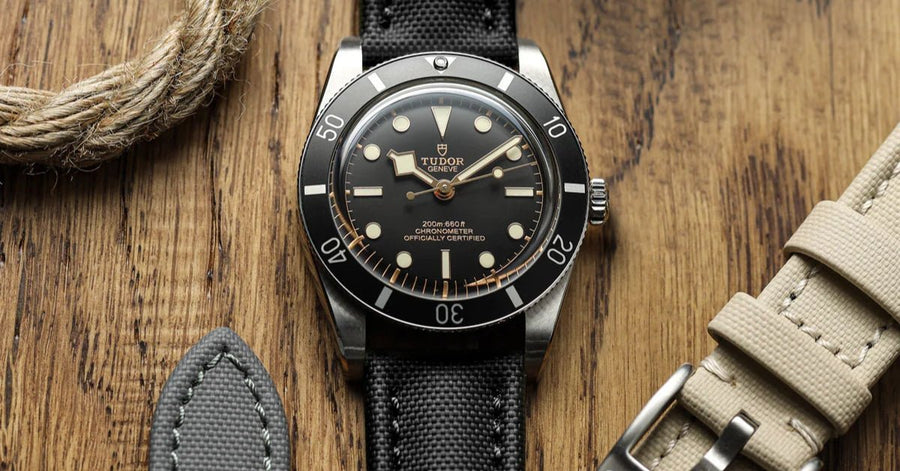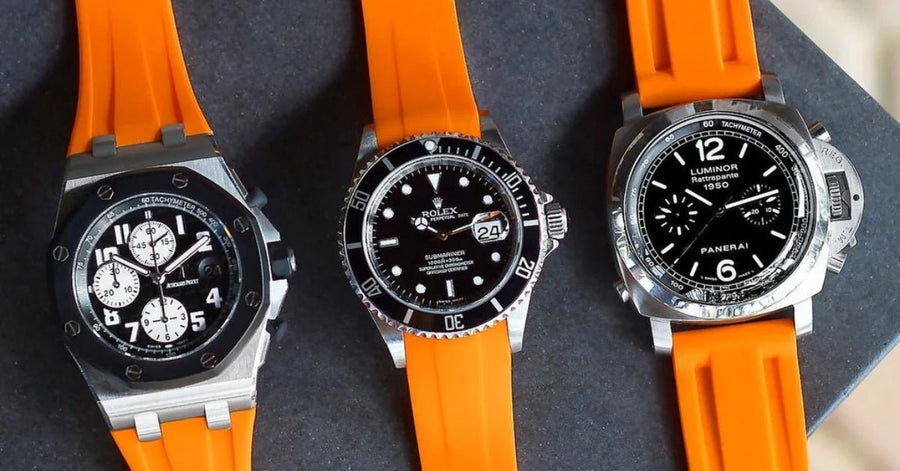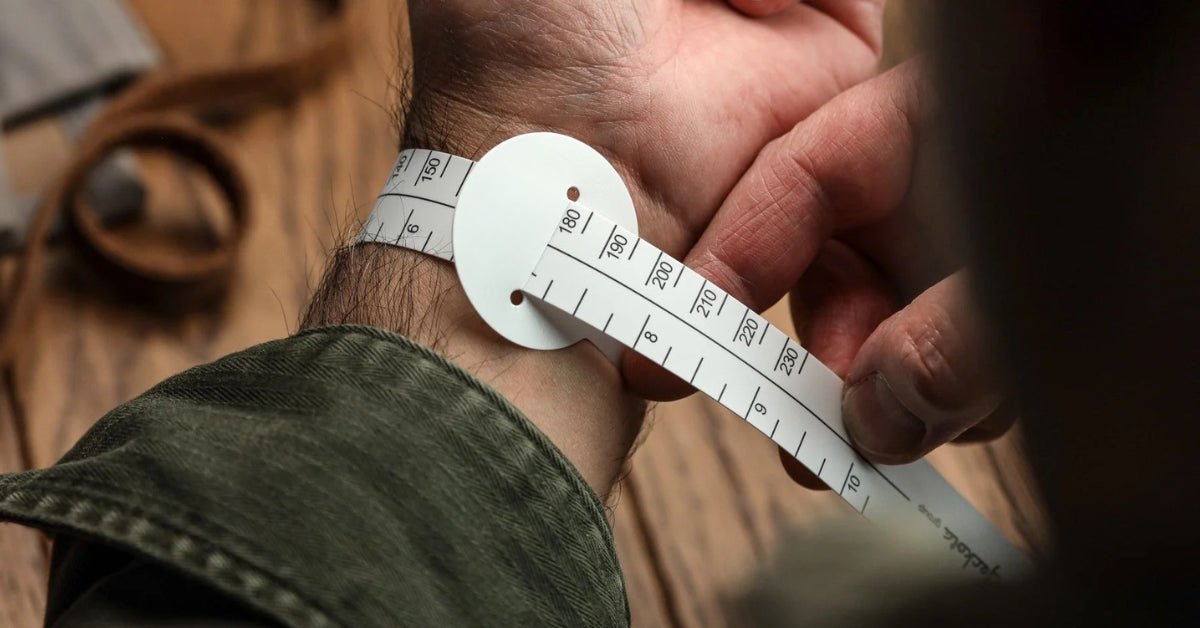
The single most common reason people return a watch strap is length. Width gets the attention because it's binary — a 20mm strap either fits a 20mm watch or it doesn't. Length is fuzzier, less talked about, and where most of the actual fit problems happen. A strap that's too long leaves a comically long tail flapping around or won't sit tight enough at the smallest hole. A strap that's too short leaves your wrist exposed at the largest hole and forces the buckle to sit awkwardly against the side of your wrist. Both situations are avoidable with about three minutes of measuring.
This guide walks through how to actually measure your wrist properly, how strap length is described on product pages, the three additional factors most articles skip (lug-to-lug, strap thickness, deployant clasps), and exact length recommendations for the most commonly bought watch references. By the end you should be able to look at any strap product page and know within thirty seconds whether the length will work for you.
What Strap Length Actually Means
A two-piece watch strap is made up of two halves: the long end (the side with the holes, where the buckle pin passes through) and the short end (the side the buckle is sewn or attached to). When you fasten the strap, the long end passes through the buckle and is held in place by the pin, with the tail tucked through one or two keeper loops on the short end.
Strap length is given as two numbers, separated by a slash — for example, 120/75mm. The first number is the long end (120mm), the second is the short end (75mm). Neither number includes the buckle itself. The total strap length is the two added together: 120 + 75 = 195mm of leather or rubber, plus another 15–25mm for the buckle on top of that.
Most aftermarket strap brands offer length in three categories:
Short: roughly 105/70 or 110/70mm Regular: roughly 115/75 or 120/75mm Long: roughly 125/80 or 130/85mm
Some brands offer extra-short and extra-long options beyond these. Helvetus straps come in Regular and Long as standard, with custom lengths available on request for very small or very large wrists.
Two important things to understand before you start measuring:
Strap length is independent of strap width. A 20mm strap and a 22mm strap can both come in the same length options. Width is about the watch; length is about the wrist.
Total strap length is more than the wrist circumference. A common misconception is "my wrist is 175mm so I need a 175mm strap." That's not how it works. The strap also has to span the watch case (the lug-to-lug distance), pass through the buckle, and have enough tail to tuck under the keeper loops. The actual usable length you need is your wrist circumference plus roughly 30–60mm extra, depending on your watch size and preference.
How to Measure Your Wrist Properly
You need a soft tailor's tape measure or, failing that, a length of string and a ruler. Stiff measuring tapes and metal rules don't curve around the wrist well enough for an accurate reading.
Step 1. Wrap the tape around the part of your wrist where you actually wear your watch. For most people that's just behind the wrist bone (the lump on the outside of the wrist, the ulnar styloid process). If you wear your watch higher up the forearm or further down toward the hand, measure there instead. Personal preference matters more than convention here.
Step 2. Pull the tape snug — the same tightness you'd want the watch strap. Not pinching, not loose. If you can comfortably slide your index finger between the tape and your wrist, you're at about the right tightness. If two fingers fit easily, the tape is too loose; if you can't fit any finger at all, it's too tight.
Step 3. Note where the tape overlaps and read the measurement in millimetres. (Or in inches if you prefer — most strap brands give both.) Common adult male wrist measurements range from about 160mm to 200mm; common adult female wrist measurements range from about 140mm to 175mm. There's plenty of variation in both directions.
If you're using string instead of a tape, mark where the string overlaps and then measure that length against a ruler.
Take the measurement two or three times at different times of day. Wrists swell slightly with heat, exercise, salt intake, and the time of day. The difference is usually 2–3mm but can be enough to push you between strap lengths. Average your readings if there's variation.
The Quick Wrist-to-Strap Length Chart
This is the rough mapping most strap brands use. Treat it as a starting point, not gospel — your specific watch (lug-to-lug distance) and personal preference both modify it slightly.
Wrist 130–150mm (5.1–5.9 inches): Short strap (around 105/70mm). Common for women and very slim wrists.
Wrist 150–165mm (5.9–6.5 inches): Short to Regular (around 110/70mm or 115/75mm). Common for women with average wrists, men with very slim wrists.
Wrist 165–185mm (6.5–7.3 inches): Regular (around 115/75mm or 120/75mm). The largest single category by population — most adult men and women with average-to-larger wrists fall here.
Wrist 185–200mm (7.3–7.9 inches): Regular to Long (around 120/80mm or 125/80mm). Common for men with larger wrists.
Wrist 200–220mm (7.9–8.7 inches): Long (around 125/80mm or 130/85mm). For genuinely large wrists.
Wrist over 220mm (8.7+ inches): Extra-long. Most premium brands offer this on request; standard product pages typically don't stock it.
If you're between two categories — say, 180mm — most brands recommend sizing up to ensure the strap can comfortably reach the centre holes rather than the smallest. A slightly long strap can be worn at any of the middle holes; a slightly short strap can't be lengthened. Size up when in doubt.
The Three Factors Most Articles Skip
Here's where most strap length guides oversimplify. There are three additional factors that change which length you actually need.
1. Your watch's lug-to-lug distance. This is the measurement from the tip of the top lugs to the tip of the bottom lugs — essentially how much of the strap is "consumed" by spanning the watch case. The smaller your watch's lug-to-lug, the more usable strap length you have left for the wrist; the larger your watch's lug-to-lug, the less.
This matters more than most people realise. Two 42mm watches can have very different lug-to-lug distances — an Omega Speedmaster at 47mm versus a Longines Skin Diver at 52.5mm — and that 5.5mm difference effectively changes your usable strap length by the same amount. On a Speedmaster, a 120/75mm strap might fit perfectly. On the Skin Diver, the same wrist might need a 125/80mm strap to compensate.
The general rule:
- Lug-to-lug under 45mm (small watch): Subtract nothing. Use the standard wrist-to-length mapping above.
- Lug-to-lug 45–50mm (average watch): No adjustment needed.
- Lug-to-lug 50–55mm (larger sport watch): Consider sizing up one strap length category if you're at the borderline.
- Lug-to-lug over 55mm (genuinely large watch): Size up one strap length category.
2. Strap thickness. A 4mm-thick padded sport strap takes more length to wrap around your wrist than a 2mm-thick dress strap, because the thicker material has to bend through a larger radius at the wrist's curvature. The difference is usually 5–10mm of effective length.
For thicker straps (sport rubber, sailcloth, padded leather): consider sizing up if you're between categories. For thinner straps (dress alligator, dress calfskin): the standard mapping is fine.
3. Deployant vs tang buckle. A deployant clasp (the folding hinge buckle) takes up a fixed amount of strap length on its own — typically 35–50mm depending on the design. That length is "consumed" by the clasp regardless of where the buckle sits. A strap that fits perfectly with a tang (pin) buckle will be slightly too long when fitted with a deployant from the same maker, because the deployant doesn't pass through buckle holes the way a pin does.
Most strap brands give length recommendations assuming a tang buckle. If you're using a deployant, you generally want to size down by one length category, or specifically pick a "deployant-length" version if the maker offers one.
Where the Buckle Should Sit
A correctly-sized strap puts the buckle near the centre of the underside of your wrist. Not on the side, not on the top. There are practical reasons for this:
- A buckle on the underside is invisible from typing, writing, and most desk-job hand positions, so the strap reads as cleaner.
- It distributes pressure evenly across the wrist rather than digging in on one side.
- It allows the watch to sit on top of the wrist, which is where the watch is supposed to be visible.
If your buckle is sitting on the side of your wrist, your strap is the wrong length. If it's sitting on top, near the watch case, the strap is dramatically too long. If it's not quite reaching the underside centre, the strap is slightly too short.
The aim is for the buckle to sit roughly directly opposite the watch face, on the underside of your wrist.
Where the Tail Should Sit
A second sign of correct strap length: the tail of the strap (the long end that passes through the buckle) should pass through the first keeper loop comfortably and rest near or just past the second keeper loop.
If the tail extends well beyond the second keeper, the strap is too long.
If the tail barely reaches the first keeper, the strap is too short.
If the tail won't reach the first keeper at all and you have to leave it loose, the strap is significantly too short.
This is the visual test you can do without measuring anything — it tells you immediately whether the length is right.
Quick Reference: Strap Length by Watch Reference
These are the lengths most aftermarket strap buyers settle on for the most-bought luxury watches. Your wrist size still matters — but these references tell you what category of length to start with.
Rolex Submariner / GMT-Master II / Daytona / Sea-Dweller / Yacht-Master. Lug-to-lug 47–50mm depending on reference. Average-wrist owner: Regular length (115/75 or 120/75mm). Larger wrist: Long length (125/80mm).
Rolex Datejust / Day-Date / Oyster Perpetual / Air-King. Lug-to-lug 44–46mm. Standard mapping applies. Average wrist: Regular length.
Cartier Santos. Lug-to-lug ~46mm. Standard mapping. The QuickSwitch system on modern Santos uses proprietary strap fit, but for traditional spring-bar Santos, regular length.
Cartier Tank, Tank Louis, Tank Américaine, Tank Solo, Tank Must. Rectangular case with shorter effective lug-to-lug. Most owners need slightly longer straps than they expect because the strap passes around a thinner case. Regular length for average wrists, occasionally Long.
Cartier Ballon Bleu, Ronde. Standard mapping.
Omega Speedmaster Moonwatch. Lug-to-lug 47mm. Standard mapping.
Omega Seamaster Diver 300M. Lug-to-lug 49mm. Standard or size up one if between categories.
Tudor Black Bay (all sizes), Pelagos. Lug-to-lug 50–52mm. Size up one category if between.
Patek Aquanaut, AP Royal Oak Offshore Diver. Integrated bracelet/strap systems with reference-specific sizing. Verify against the OEM strap.
Patek Calatrava, AP Code 11.59, Vacheron Patrimony, Lange Saxonia. Lug-to-lug 42–46mm depending on reference. Standard mapping.
IWC Pilot, Big Pilot. Lug-to-lug 50–55mm. Size up one category — these are large watches.
Panerai Luminor, Radiomir. Lug-to-lug 53–56mm depending on reference. Size up one category at minimum.
Hublot Big Bang. Lug-to-lug 49–53mm depending on reference. Size up if between.
Tag Heuer Carrera, Aquaracer. Lug-to-lug 46–49mm depending on reference. Standard mapping.
If your watch isn't on this list, the simple test is to measure the lug-to-lug yourself with a ruler (lug tip to opposite lug tip). Anything under 50mm is "standard" for length purposes. Anything over 50mm benefits from sizing up.
The Wetsuit and Cuff Question
Two situations affect the length you need beyond standard wrist measurement.
If you dive in a wetsuit. A wetsuit cuff adds 6–10mm of effective wrist circumference depending on the suit thickness. If you plan to wear the watch over the wetsuit, measure your wrist while wearing the cuff — or buy a strap with extra holes (most dedicated dive straps have additional holes for exactly this). Some makers offer dedicated "diver extension" loops or extra-long versions for wetsuit use.
If you wear shirt cuffs over the watch. No adjustment needed — the cuff goes over the strap, so the strap itself just fits the wrist. The only consideration is keeping the strap and watch slim enough that the cuff sits comfortably over them. This is a styling preference rather than a sizing issue.
Frequently Asked Questions
My wrist is 175mm. Do I need a 175mm strap? No. Total strap length needs to span your wrist plus the watch case plus the buckle, so the strap is always longer than your wrist circumference. For a 175mm wrist on an average-sized watch, expect to need about 195–205mm of total strap length (e.g., a 120/75mm strap with the buckle on top).
The strap I bought is too long. Can I shorten it? For leather straps, yes — most strap makers will trim and re-stitch to your length, and a competent watchmaker or leather worker can also do it. For rubber and sailcloth straps, generally no — though some rubber straps (Helvetus's CTS cut-to-size range, for example) are explicitly designed to be trimmed at home using a sharp craft knife.
The strap I bought is too short. Can I lengthen it? Effectively no. You can't add length to a finished strap. Returning and exchanging for the next size up is the only fix.
Can I add an extra hole to a leather strap? Yes, with a leather hole punch. Most premium straps come with 7–9 holes already, but if you genuinely need an extra at the smallest end, a leather punch (£10–15 from any leather goods shop) produces a clean hole. Test on a scrap of leather first.
Why do my strap holes stretch out of round over time? Wearing the strap at the same hole every day stresses that single hole repeatedly. The fix is rotation — use the next hole over occasionally to spread the wear. Also, a strap that's slightly too tight (forcing the pin against the hole edge) wears holes faster than one at the right length.
What if I'm right on the boundary between two length sizes? Size up. A slightly long strap can be worn at any of the middle holes and looks neat as long as the tail tucks under the keepers. A slightly short strap forces you to wear it at the largest hole, which is less secure and looks visibly tight.
Does taper affect length? Not directly. Taper (where the strap narrows from the lug end to the buckle end) affects the visual proportions of the strap but doesn't change the measured length. A 22/18mm strap (22mm at the lugs, tapering to 18mm at the buckle) and a non-tapered 22/22mm strap of the same length will fit the same wrist.
Should I measure my wrist tight or loose? Tight enough that one finger fits comfortably between the tape and your skin. Looser than that and the strap will slide around. Tighter than that and the strap will pinch and leave marks.
What length do most aftermarket buyers actually order? Roughly 70% of aftermarket strap buyers order Regular length (around 120/75mm). Long length is 15–20%. Short length is around 10%. Specialty extra-long and extra-short are the remainder.
The Bottom Line
The right strap length is the single biggest factor in whether a strap actually fits properly, and it's the easiest thing to get wrong if you don't measure. A soft tape measure and three minutes of attention solve most of the problem. Add 30–60mm to your wrist circumference for usable length, account for a larger lug-to-lug or a thicker strap by sizing up one category, and switch to a shorter strap if you're using a deployant clasp.
When in doubt, size up. A strap that's slightly long can be worn at any of the middle holes and looks fine. A strap that's slightly short forces you to wear it at the largest hole, which is uncomfortable and looks bad. The risk profile is asymmetric, and the right call is almost always the larger length.
Helvetus straps come in Regular and Long lengths as standard across the curved-end FKM rubber, straight-end FKM rubber, leather, sailcloth, alligator, suede, and ostrich collections, with our CTS cut-to-size rubber range available for buyers who want to trim to their exact wrist length the same way Patek Philippe does on the Aquanaut. Custom length on request for very small and very large wrists.
Most of our customers wear Rolex or Cartier — both well-served by the standard length range. The Rolex strap collection and the Cartier strap collection include length options matched to the most common references. Use our Strap Finder to match the right width, end-fit, and length to your watch reference automatically. Browse the full range at helvetus.com, or read more on the Helvetus blog.