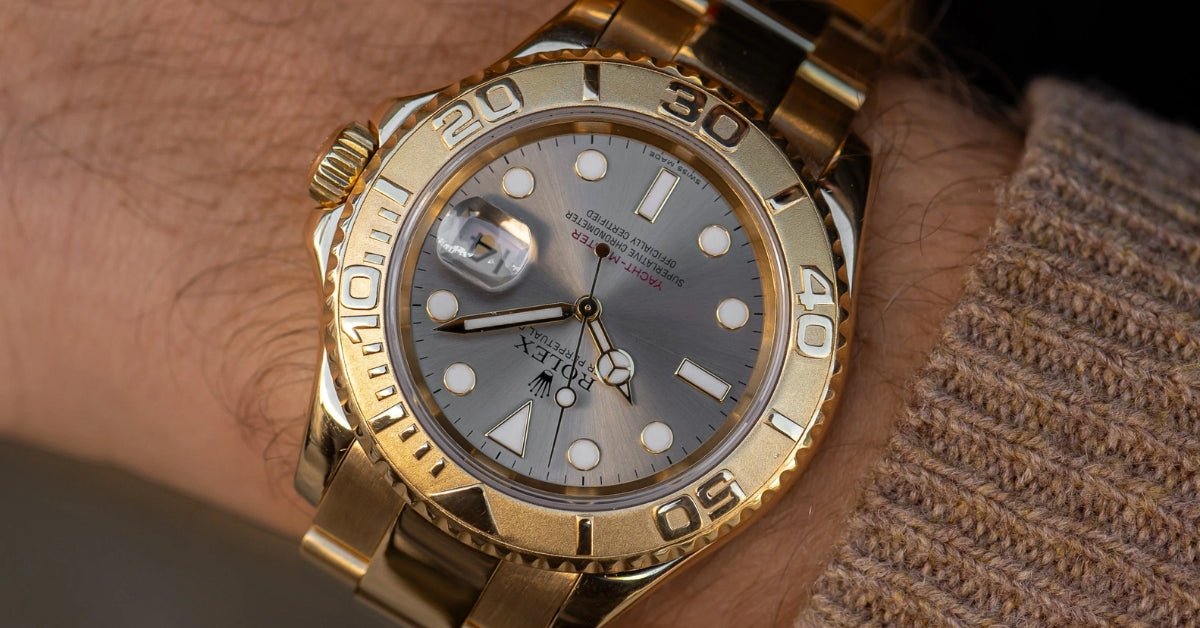
Here's the thing most people get wrong about the Yacht-Master: it didn't start in steel. When Rolex introduced the line in 1992, it arrived as the 16628 — 40mm, solid 18k yellow gold, gold bezel, gold bracelet, gold crown. The Rolesium version with the platinum bezel came years later, and the two-tone later still.
So the 16628 isn't the gold edition of a sports watch. It's the watch, and everything else in the Yacht-Master 40 family descends from it.
Strap size and fit for the Yacht-Master 16628
The 16628 is a 40mm case with a 20mm lug width.
The Yacht-Master line runs several widths depending on case size, so on Helvetus product pages select the 40mm option:
→ All rubber straps for the Rolex Yacht-Master
Two things to route around before you order:
- The 42mm Yacht-Master and the smaller 37mm and 29mm references are different cases with different widths. Message support with your reference rather than guessing.
- Oysterflex models need the separate Oysterflex line entirely — these curved straps aren't for them.
On buckles, take the pin buckle. The deployant version is built around the modern Rolex deployant clasp. The 16628 came on the flip-lock clasp of its own generation, which is a different fitting. The pin buckle version includes its own steel buckle and works regardless — and on a watch where the clasp is solid gold, keeping it out of daily handling isn't a bad outcome either.
What the 16628 is
The Yacht-Master launched in 1992 as a full 18k yellow gold watch: gold case, gold Oyster bracelet, and the raised, highly polished gold numerals on a rotating 60-minute bezel that remain the line's signature. Inside is the same calibre 3135 generation that ran through the Submariner and Datejust of the era. Sapphire, date at three under a cyclops, 100 m.
One detail that separates it from every two-tone Yacht-Master: the 16628 has a gold winding crown. Rolex gave the bi-colour Yacht-Masters — the 16623 and later the Everose 116621 — a steel crown instead. If you're comparing photos, the crown is the fastest tell.
The bezel is the part worth pausing on. Those numerals stand proud of a recessed surface and they're polished to a mirror, which is why a Yacht-Master bezel catches light in a way no other Rolex bezel does. It's also the single most visually important thing on the watch, and it isn't going anywhere when the bracelet comes off.
Why the 16628 belongs on rubber
Because Rolex built a sports watch and then made it out of jewellery. The bezel is a timing bezel. The case is rated to 100 metres. The whole design brief is sailing. And then the entire thing is solid gold, which means almost no 16628 has ever been used for any of it — not because gold can't take water, but because nobody takes a solid gold Oyster bracelet anywhere it might meet a cleat, a winch or a pontoon.
A strap is the only thing that resolves that. It's the first time this watch can be worn the way its own bezel suggests.
And it's the right size to actually wear. Forty millimetres in solid gold is heavy, but the proportions are modest by modern standards — this is a much easier watch to live with than a 44mm gold sports watch. The bracelet is the only thing making it feel like an occasion piece. Take it off and the 16628 becomes something you can put on without thinking about it.
Meanwhile the bracelet is the part that only ever gets worse. The bezel and case age fine. Solid gold links don't: they scratch, and gold can't be refinished indefinitely, because every polish removes material that doesn't come back. On a watch where the bracelet is a serious share of the total value, that's worth avoiding on ordinary days.
Nothing about the watch's identity leaves with it. Gold case, gold bezel, gold numerals, gold crown — all still there.
Four strap colours for the 16628
Every pick here is a cool colour, and that's deliberate. On a watch that is entirely yellow gold, a warm strap doubles down and the whole thing tips into jewellery. Cool colours give the gold something to sit against, and it reads richer for the contrast.
1. Black — the one that makes the gold read as gold
Black is the starting point on any solid gold watch. It removes every competing element, and the gold case, bezel and numerals separate hard against it. The watch also looks slightly smaller and considerably sharper.
If you're buying one strap for this reference, buy this one.
→ Black rubber strap for the Rolex Yacht-Master
2. Navy — the one you can wear anywhere
Navy and yellow gold is the oldest reliable pairing in menswear and it works exactly as well on the wrist. It's darker and calmer than black is stark, and it makes a solid gold watch look deliberate under a sleeve rather than celebratory.
This is the strap for wearing the 16628 to things, rather than for things.
→ Navy blue rubber strap for the Rolex Yacht-Master
3. Light blue — the nautical one
The Yacht-Master's whole reason for existing is the water, and light blue is the colour that says so without a costume. Against yellow gold it reads like sunlight on a hull: bright, summer, and unmistakably intentional.
It's the pick that makes a gold Yacht-Master look like it's meant to be near a boat, which is the entire point of the reference.
→ Light blue rubber strap for the Rolex Yacht-Master
4. Grey — graphite against gold
The most modern-looking option here. Grey is cooler than black and softer than navy, and it does something neither manages: it makes yellow gold look contemporary rather than traditional. On a watch from 1992 that's a genuinely useful trick.
Best in daylight, and best if you find the gold a little much on the bracelet.
→ Grey rubber strap for the Rolex Yacht-Master
Warmer options — brown, beige, white and more — are in the Yacht-Master collection if you'd rather lean into the gold than against it. Just select the 40mm option.
Related references
- 16623 — the two-tone steel and yellow gold Yacht-Master. Same 40mm case, same 20mm fit, steel crown.
- 116622 — the six-digit Rolesium with the platinum bezel.
- 16622 — the five-digit Rolesium, same case and generation as this one.
- 126621 — the current Everose Rolesor Yacht-Master 40.
- Yacht-Master 42, 37 and 29mm — different cases, different widths.
Quick answers
What lug width is the Rolex Yacht-Master 16628? 20mm, on a 40mm case.
What do I select when ordering? The 40mm option. The 42mm and smaller Yacht-Masters use different widths.
Pin buckle or deployant? Pin buckle. The deployant version targets the modern Rolex deployant clasp, and the 16628 came on the flip-lock of its generation.
How do I tell a 16628 from a two-tone Yacht-Master? The crown. The full gold 16628 has a gold crown; the bi-colour Yacht-Masters have a steel one, even where the bezel is gold.
Before you order
The 16628 is a sailing watch that has almost certainly never sailed, and the bracelet is the reason. A strap gives it back a use, takes a lot of weight off the wrist, and keeps the solid gold links out of the one situation where they get permanently damaged.
Helvetus straps for the Yacht-Master are cut for the 40mm case, come with a lifetime warranty on rubber, ship free worldwide with no import costs, and are worn by 50,000+ customers. Black first, then light blue when the weather turns.