There's one number on a watch that gets ignored more than any other, and it's the one you absolutely have to know before you buy a strap. Lug width is the measurement that decides whether a strap will fit your watch at all. Get it wrong by a single millimetre and the strap either won't sit between the lugs or it'll leave a gap so visible it'll bother you every time you look down at your wrist.
The good news is that measuring lug width is genuinely simple. The bad news is that most people get it wrong on the first try because they end up measuring the wrong part of the watch. This guide walks through exactly how to do it, what tools you actually need (the cheapest option costs less than a coffee), and what to do when the answer comes back as an awkward number like 21mm.
What "Lug Width" Actually Means
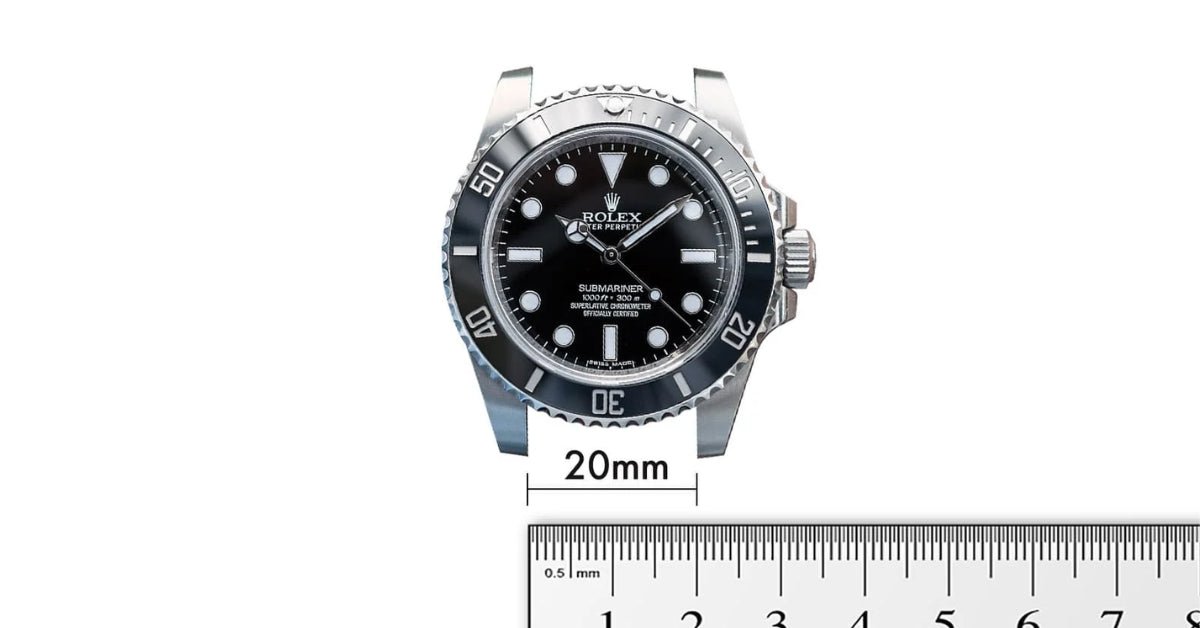
The lugs are the two pairs of metal arms that protrude from the top and bottom of your watch case. They're what hold the strap in place. The lug width is the distance between the inside of those arms, measured in millimetres, where the end of the strap actually slots in. You'll also see it called strap width, band width, or just "width" on product pages. They all refer to the same number.
A few things worth clearing up immediately, because these are the mistakes that cost people money:
Lug width is not the same as the width of your existing strap measured at its widest point. Most straps match the lug width exactly, but worn or stretched straps can read slightly off. Always measure the watch itself if you can.
Lug width has nothing to do with the case diameter. A 41mm watch and a 36mm watch can both have a 20mm lug width. Case size is the diameter of the round part you read the time on. Lug width is just the gap where the strap goes.
Lug width is always a whole number on modern watches, almost always between 16mm and 24mm. If you measure and get 20.5mm, your ruler is lying to you. Round to the nearest whole millimetre.
Why Getting It Right Matters
A strap that's too narrow leaves a visible gap on either side of the lugs. Once you've noticed it, you can't unnotice it. A strap that's too wide simply won't fit. You'll fight it onto the watch, the spring bars won't seat properly, and you'll risk scratching the lugs in the process. Strap widths are made in whole millimetres because watch lug widths are in whole millimetres, and they're meant to match exactly.
There's also a comfort component most people don't think about. The wrong width subtly shifts how the watch balances on the wrist. Once you've felt how a properly-sized strap sits compared to a near-miss, the difference becomes obvious.
Three Ways to Measure Your Lug Width
You only need one of these methods, but I'll cover all three because each has its place.
1. Digital Calipers (most accurate)
If you own digital calipers — the kind with the LCD readout — this is the easiest option and takes about ten seconds. Set the calipers to millimetres, slip the inner jaws between the lugs, and gently expand them until they touch both lugs. Read the number on the screen.
The reason calipers are best is that they measure the actual gap, not the strap, and they read down to a tenth of a millimetre. If you don't already own a pair, a basic digital caliper costs under $15 and is genuinely useful for any kind of small-object measuring around the house.
2. A Standard Ruler (the free method)
This works fine if you don't have calipers. Lay the watch on a flat surface, take any ruler with millimetre markings, and place it across the gap between the lugs. Line up the zero with the inside edge of one lug and read off the number on the other side.
A few tips to get this accurate:
Use the millimetre side of the ruler, not inches. Converting fractional inches to millimetres is where most measurement mistakes happen.
Get your eye directly above the ruler. Reading at an angle (parallax error) is the second most common mistake, especially with cheap rulers that have thick markings.
If the strap is still attached, either remove it first or measure right at the very tip of the lug end where the spring bar holes are. Don't try to estimate around an existing strap.
3. Check the Back of Your Existing Strap
Most leather, rubber, and nylon straps have the size stamped or printed on the underside, near the buckle end. You'll see something like "20" or "20/16" or "20mm." That first number is your lug width. The second number, when present, is the buckle width — the strap tapers from 20mm at the lugs to 16mm at the buckle.
This method is fine if you're confident the strap that came on the watch was the correct size. It doesn't help you for replacement straps you bought elsewhere, or for vintage watches that came on the wrong strap. When in doubt, measure the watch directly.
What to Do With Odd Sizes (19mm, 21mm, 23mm)
Most modern watches are designed around even numbers — 18, 20, 22, 24. But plenty of watches break that rule, and the new Rolex Submariner 41mm is the most famous example, with a 21mm lug width. Vintage watches, dress watches, and several Cartier models also use odd widths.
The standard advice is to size up. A 22mm strap will fit a 21mm gap if you squeeze it in slightly. This works with rubber and leather because both materials have a small amount of give. Don't try to size down. A 20mm strap on a 21mm watch will leave gaps on both sides and the spring bars will be visible from the side.
For watches with truly unusual widths, look for brand-specific straps that are made to the exact measurement. At Helvetus we make rubber straps for the Rolex Submariner 41mm in the correct 21mm width with a curved end designed for that specific case profile, and the same applies to our Cartier Santos, Tank, Daytona, and other model-specific pieces — the lug width is matched exactly so the fitting is flush, not squeezed.
Quick Reference: Lug Widths for Popular Watches
Here are the lug widths for some of the most common watches we get strap requests for. Always verify against your specific reference number, because brands occasionally change widths between generations.
Rolex Submariner 41mm (124060 / 126610LN): 21mm Rolex Submariner 40mm (114060 / 116610LN): 20mm Rolex Daytona (116500LN / 126500LN): 20mm Rolex GMT-Master II 40mm: 20mm Rolex Datejust 41: 21mm Rolex Datejust 36: 20mm Rolex Day-Date 40: 20mm Rolex Explorer I 36/40mm: 20mm (varies by generation) Omega Speedmaster Moonwatch 42mm: 20mm Omega Seamaster Diver 300M: 20mm or 21mm depending on reference Tudor Black Bay 41: 22mm Tudor Black Bay Fifty-Eight: 20mm Tudor Pelagos 42: 22mm Cartier Santos Medium (WSSA0029): uses Cartier's QuickSwitch system, ~21mm at the case Cartier Tank: varies significantly by model — verify your specific reference Patek Philippe Aquanaut 5167: 21mm
If your watch isn't on this list, our Strap Finder can match almost any modern luxury watch to the correct lug width — just enter the brand and model.
Special Cases — When Lug Width Isn't the Whole Story
A few situations make the measurement more complicated than just measuring the gap.
Integrated bracelets. Watches like the Patek Philippe Nautilus, Audemars Piguet Royal Oak, and the modern Cartier Santos in some configurations don't use a standard lug system. The bracelet or strap end is shaped to integrate with the case profile. A standard 20mm or 22mm strap won't fit even if the gap measures that wide. You need a strap engineered specifically for the model.
Curved end straps. Watches like the Omega Speedmaster, Rolex Submariner, and most modern divers have a slight curve where the lugs meet the case that a flat-ended strap can't quite match. The lug width is still measured the same way, but the fit will look better with a curved-end strap that follows the case profile rather than a straight-cut one. This is one of the main reasons aftermarket straps for these watches need to be designed for the specific reference, not just the lug width.
Drilled lugs. Older watches and some current Tudor models have small holes drilled through the outside of the lugs. Drilled lugs don't change the width measurement at all — they just affect how easily you can change the strap, since you can push the spring bar out from the side using the small hole instead of compressing it from the top.
Don't Forget the Length
Once you know your lug width, the next question is strap length, which is determined by your wrist size, not your watch. The easiest method is to wrap a piece of string or a strip of paper around your wrist where you'd normally wear the watch, mark where it overlaps, then lay it flat against a ruler.
Most strap brands, including Helvetus, offer Short, Regular, and Long lengths. As a rough guide:
Wrist under 6.5 inches (165mm): Short Wrist 6.5–7.5 inches (165–190mm): Regular Wrist over 7.5 inches (190mm): Long
Length affects how the watch sits on your wrist and how much strap tail extends past the buckle. Width affects whether the strap fits at all. They're separate measurements and both matter.
Frequently Asked Questions
Can a 22mm strap fit a 20mm watch? No. The strap will be too wide to fit between the lugs. You'd have to physically trim the strap end, which most people shouldn't attempt at home and which voids any warranty on the strap.
Can a 20mm strap fit a 21mm watch? Technically yes, but you'll see gaps on both sides where the spring bars are exposed. It looks bad and the strap can shift. Better to size up to 22mm and let the slight squeeze hold the strap in place — or buy a strap made specifically for that 21mm reference.
Where is the lug width on a Rolex? Rolex doesn't print the lug width on the watch itself. You either measure between the lugs directly or check the published specs for your specific reference number. The most common modern Rolex lug widths are 20mm and 21mm.
Is lug width the same as case width? No. Case width is the diameter of the watch face. Lug width is the gap between the lugs where the strap attaches. A 40mm-case watch can have a 20mm or 22mm lug width. The two numbers aren't related.
What if my watch has a 19mm or 17mm lug width? Both exist, mostly on vintage and dress watches. Some modern Omega Seamaster Aqua Terra references are 19mm. For these widths, look for straps made explicitly in that size — sizing down from 20mm leaves gaps on both sides, and sizing up from 18mm requires squeezing the strap end, which doesn't always work cleanly with stiffer materials.
For broader background on watch strap construction and terminology, Wikipedia's overview of the watch strap is a solid neutral reference.
The Bottom Line
Measuring your lug width takes thirty seconds with the right approach and saves you from buying a strap that doesn't fit. Use calipers if you have them, a millimetre ruler if you don't, and double-check by reading the back of your existing strap. Round to the nearest whole millimetre. If you get an odd number like 21mm, either size up to the next strap width and squeeze it in, or buy a strap made specifically for your watch reference.
Once you've got your number, the rest is the fun part — picking the material, the colour, and the construction that'll completely change how your watch looks. At Helvetus we make rubber, leather, sailcloth, alligator, suede, and ostrich straps in every standard lug width for almost every luxury watch out there, with model-specific fits for Rolex, Cartier, Omega, Tudor, Panerai, and others. Browse the full collection at helvetus.com or use our Strap Finder to skip the guesswork entirely.
If you've measured your lug width and you're now wondering whether to go with rubber or leather for your next strap, we wrote a separate guide on Rubber vs. Leather Watch Straps that breaks down the trade-offs.