Most watches make you work for a strap change. You need a spring bar tool, a steady hand, and a tolerance for the possibility of putting a scratch across a lug you will notice forever.
The Heritage Ranger does not. It has drilled lugs — actual holes through the case — and that one detail makes it the easiest watch Tudor has ever made to re-strap, and the one most worth owning several straps for.
Strap size and fit guide — and there are two Tudor Rangers
Your Tudor Heritage Ranger (Ref. 79910) has a 41mm case and a 22mm lug width, with a 48mm lug-to-lug.
This is the critical bit: there are two watches called the Tudor Ranger and they do not share a strap.
| Watch | Years | Case | Lug width |
|---|---|---|---|
| Heritage Ranger 79910 | 2014–2022 | 41mm | 22mm |
| Ranger M79950 | 2022 onward | 39mm | 20mm |
Tudor replaced the Heritage Ranger in 2022 with a smaller, redesigned model that kept the name. Two millimetres smaller in the case, two millimetres narrower at the lugs. They look closely related, they are frequently confused, and a strap bought for one will not fit the other.
How to tell in two seconds: look at your crown. The Heritage Ranger 79910 wears the Tudor rose; the rest of the modern collection, including the 2022 Ranger, uses the shield. Monochrome made a point of this at launch and it remains the fastest identifier. If your lugs have holes drilled through them, that also settles it — the 79910 has them and the current Ranger does not.
The 79910 is a discontinued reference, so there is no model-specific cut for it in our Tudor range. Order 22mm from any of our universal ranges — it uses ordinary spring bars and there is no fitting quirk at all.
Checklist: 41mm case, 22mm lugs, standard spring bars, drilled lugs.
Why this is the Tudor to build a strap rotation on
Two facts, and together they are the whole argument.
One: the lugs are drilled. You can push a spring bar out from the outside with a pin, a paperclip or the pointed end of the tool that came in the box. No sliding a forked tool between the strap and the case, no pressure against the lug's inner edge, and — the part that actually matters — no realistic way to scratch the case. The single biggest reason people who own nice watches do not change straps is the fear of marking them, and on this watch that reason does not apply. A swap takes under a minute and carries essentially no risk.
Two: Tudor built it that way on purpose. The Heritage Ranger was offered with four different factory mounts — a steel bracelet with retro straight end links, a tan leather strap, a brown bund-style leather strap with a deployant, and a camouflage fabric strap. Four. No other Tudor of the era came with anything like that range of options, and it tells you exactly how the brand expected the watch to be used.
So the question with this reference is not really "which strap". It is "which three", because the case was designed around the assumption that you would keep changing your mind.
There is a third, smaller point worth knowing. At 12mm thick with very thin lugs and a full satin-brushed case, the Ranger has almost no visual bulk and nothing shiny to fight with. It takes thick straps and thin ones equally well, which is not true of the Black Bay, and it means a rotation can genuinely span leather, fabric and rubber rather than three variations on the same thing.
The dial: matte black, painted indices, one red hand
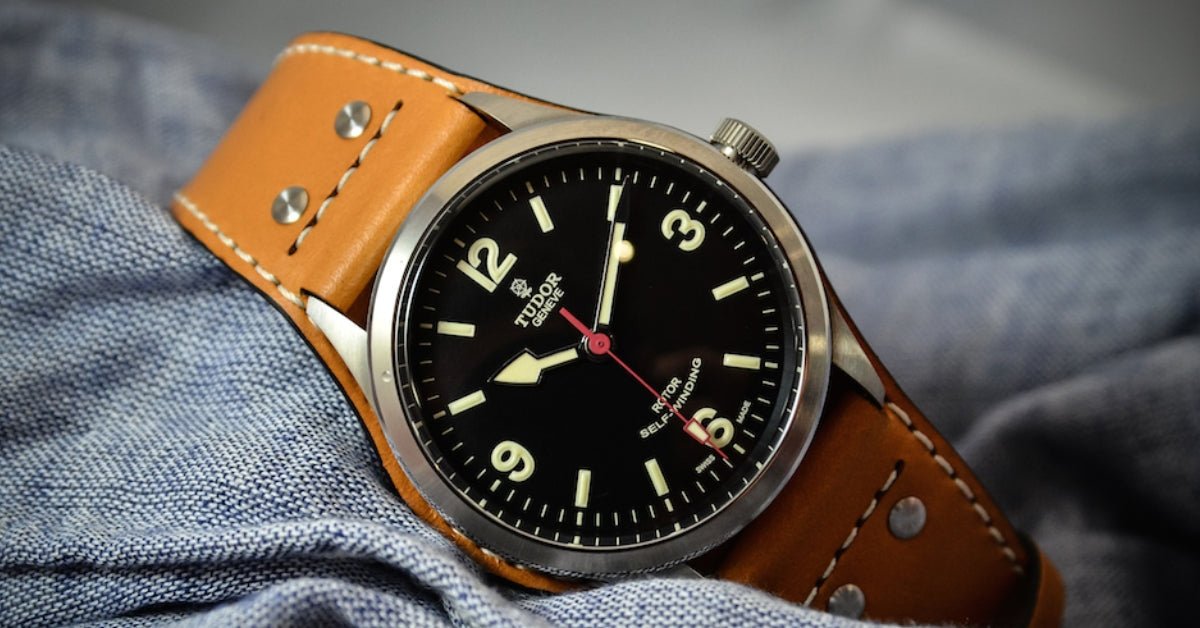
The Heritage Ranger's dial is finely textured matte black, slightly domed, with 3, 6, 9 and 12 in painted rather than printed Arabic numerals — deliberately thick, to mimic the way aged tritium sits proud on a vintage dial. The hands are the distinctive Ranger set, and there is a single red seconds hand.
That is the entire palette: black, cream-toned painted indices, and one thin red line that sweeps. There is no bezel colour, no gilt, no date. So a strap here is not competing with anything — it is supplying the only other element in the picture, which is why the four options below genuinely change the watch rather than just accessorising it.
The four straps to build a rotation with
Tan or brown leather — the factory look, and the one to start with. Tudor sold more Heritage Rangers on tan leather than on anything else, and it is the pairing the watch was designed around. Warm leather against a matte black dial with cream-toned painted numerals is a properly period combination — it reads as a 1960s field watch rather than a modern homage. Mid-tan is the most authentic; a darker brown makes the watch look more expensive and less rugged. If you buy one strap for this watch, buy this one. Leather Watch Straps — choose 22mm
Sailcloth — the field-watch answer without the costume. The 79910 came with a camouflage fabric strap from the factory, which is a strong look but a specific one. Sailcloth gives you the same technical, woven character without the pattern: it suits a military-derived watch, it handles sweat and rain far better than leather, and it keeps the Ranger looking like a tool rather than a collectible. This is the one to wear when you are actually doing something. Sailcloth Watch Straps — choose 22mm
Straight-end FKM rubber — the option Tudor never offered. The Heritage Ranger is waterproof to 150m, which is more than a field watch needs and plenty for swimming. Tudor never sold it on rubber, but the specification supports it completely, and on a fully satin case with thin lugs a straight-end rubber strap looks purposeful rather than sporty-by-default. Black keeps the red seconds hand as the only colour on the watch. Our straight-end range covers 20mm, 22mm and 24mm. Straight-End FKM Rubber Straps — 20mm, 22mm, 24mm
Suede — the one that surprises people. A matte case and a matte dial want a matte strap, and suede is the only material that matches both. On the Ranger it produces something that looks considered rather than utilitarian, works particularly well in grey or dark brown, and pairs with wool and cord in a way smooth leather never quite manages. It is also the least likely strap anyone else will have on theirs. Suede Leather Watch Straps — choose 22mm
Full range here: All General Straps
Getting the order right
41mm, 22mm, standard spring bars. Choose 22mm in whichever range suits you — no model selection required. And because the lugs are drilled, you will not need a proper tool to fit it.
If you own other Tudors:
- Tudor Black Bay 41 Blue 79230B Strap Guide — 41mm, also 22mm
- Tudor Black Bay Chrono 79360N Strap Guide — 41mm, 22mm
- Tudor Black Bay Ceramic 79210CNU Strap Guide — 41mm, 22mm
FAQ
What lug width is the Tudor Heritage Ranger 79910? 22mm, on a 41mm case with a 48mm lug-to-lug.
Is it the same as the current Tudor Ranger? No. The 2022 Ranger (M79950) is 39mm with 20mm lugs. The Heritage Ranger 79910 is 41mm with 22mm. Same name, different watches, different straps.
How do I tell which Ranger I have? Check the crown: the Heritage Ranger 79910 carries the Tudor rose, the current Ranger uses the shield. The 79910 also has drilled lug holes, which the newer one does not.
What are drilled lugs and why do they matter? They are holes through the outside of the lugs, so a spring bar can be pushed out with a pin rather than levered from between the strap and the case. It makes strap changes faster and effectively removes the risk of scratching the lugs.
Can I wear the Heritage Ranger on rubber? Yes. It is waterproof to 150m. Tudor never offered rubber for it, but nothing about the watch objects to it.
Final thoughts
The Heritage Ranger is the most honest watch Tudor has made in the last fifteen years — no date, no bezel, no polish, one red hand — and it is the only one built with strap changes designed into the case. Four factory options and drilled lugs is not an accident.
Helvetus carries 22mm across leather, sailcloth, rubber and suede, so a full rotation is available in one place. Shipping is free worldwide with no import costs, leather straps carry a one-year warranty and every rubber strap a lifetime warranty, and more than 50,000 customers have already made the swap.