For most of its history, Rolex treated rubber the way a tailor treats polyester. Then, in 2015, an Everose Yacht-Master arrived on something called the Oysterflex, and the argument was more or less over. It is, by a wide margin, one of the most comfortable things the brand has ever bolted to a case.
What nobody warns you about is everything that comes after.
Your Oysterflex arrived in one colour: black. It was sized once, at the counter, on the day you bought the watch — and unless your wrist has stayed exactly the same ever since, that fit is a compromise you've been quietly living with. And rubber, however good, is a consumable. Sunscreen, salt water, gym chalk and six summers will eventually tell.
This guide covers what the Oysterflex actually is, which references wear it, how its unusual sizing system works, and what your options are when you want a different colour, a different length, or simply a fresh strap without surrendering the watch for weeks.
What the Oysterflex actually is
Rolex insists on calling it a bracelet rather than a strap, and for once the marketing department is being literal.
Underneath the rubber sits a flexible metal blade in a titanium and nickel alloy. That blade is what carries the load and gives the Oysterflex its distinctive behaviour on the wrist — it holds a shape rather than draping like leather. The blade is then overmoulded in a high-performance elastomer, which is what you see and feel.
Turn one over and you'll find the detail most owners never notice: a patented longitudinal cushion system running down the underside. Those raised ribs keep the watch stable and let air move between rubber and skin, which is the entire reason an Oysterflex doesn't turn clammy at 30 degrees the way a flat rubber strap does.
It finishes in an Oysterlock safety clasp with Glidelock, giving you roughly 15 mm of fine adjustment in 2.5 mm steps, tool-free. That clasp is a genuinely brilliant piece of engineering, and — this matters later — it's the part you keep.
Which Rolex models come on the Oysterflex
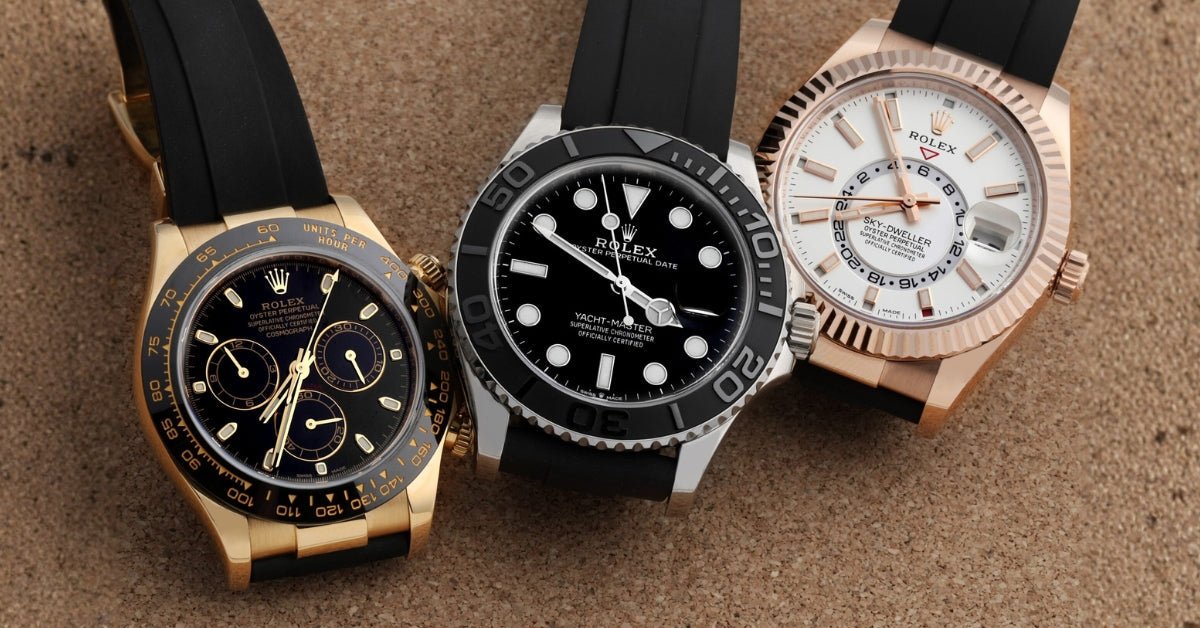
The Oysterflex debuted on the Everose Yacht-Master in 2015 and has stayed exclusive to precious-metal sports models ever since. Rolex has never sold it as a standalone accessory, and no authorised dealer will fit one to a watch that didn't ship with it.
| Model | Lug width |
|---|---|
| Yacht-Master 37 | 18 mm |
| Yacht-Master 40 | 20 mm |
| Yacht-Master 42 | 21 mm |
| Cosmograph Daytona (gold) | 20 mm |
| Sky-Dweller | 21 mm |
Gold Daytonas moved from leather to Oysterflex in 2017, and the 2023 generation carried it over unchanged. The Sky-Dweller joined more recently. Between them, the Daytona and the Yacht-Master account for the overwhelming majority of Oysterflex watches in circulation.
Note what those numbers mean in practice: 20 mm and 21 mm cover four of the five sizes. If you own a gold Daytona, a Yacht-Master 40, a Yacht-Master 42 or a Sky-Dweller, you're in the two most common widths.
Why owners go looking for a replacement
It's rarely one reason. In our experience it's usually one of these five.
The sizing was set by someone else. The Oysterflex has no links and no adjustment holes. Rolex builds it in six length codes per side, and a dealer picks the combination at the point of sale. Buy pre-owned and you inherit whatever the previous owner's wrist required — which is why so many second-hand Daytonas sit awkwardly high or hang loose at the clasp.
Black, and only black. A Rolex Oysterflex is black. That's the entire palette. Anyone who has seen a turquoise-dial Daytona on a matching strap understands the appeal of the alternative.
Wear. Elastomer is tough but not eternal. Six or seven years of sunscreen, chlorine and daily flexing leaves its mark, and a tired strap makes a five-figure watch look neglected in a way a scratched bracelet never does.
Preservation. Plenty of collectors want the factory strap tucked away untouched — original, unmarked, ready for resale — and something else on the wrist for everyday use.
Time. Replacing an Oysterflex through official channels means going through a dealer or service centre, waiting, and paying accordingly. Sometimes you just want the watch back on your wrist this week.
The Helvetus alternative: a made-to-fit FKM Oysterflex strap
We built our Oysterflex collection around a simple idea — keep everything Rolex got right, and fix the three things that frustrate owners.
It keeps your original clasp
This is the part people get wrong about aftermarket Oysterflex straps. Ours isn't a full bracelet replacement. It connects to your existing Oysterlock clasp, which means you keep the gold, you keep Glidelock, and you keep the piece of the watch that's genuinely irreplaceable. Spring bars are included, and your original Rolex spring bars fit perfectly if you'd rather reuse them.
Fitting takes about ten minutes with a spring bar tool.
FKM, not silicone
The strap is made from FKM fluoroelastomer — the same family of rubber used in marine and aerospace sealing, chosen because it shrugs off exactly what kills cheaper straps. Sweat, chlorine, salt, sunscreen, UV. It doesn't go chalky, it doesn't fade, and it doesn't develop that faint tacky film that silicone straps get after a season.
It also doesn't attract lint, which anyone who has owned a matte black rubber strap will appreciate more than they expect to.
Ten colours instead of one
Black remains the default and the best seller — our black Oysterflex strap is the closest thing to a like-for-like factory replacement and outsells everything else combined. But the range runs to white, grey, navy, blue, light blue, turquoise, green, red and orange.
A few pairings worth knowing: turquoise on the turquoise-dial Daytona is the obvious one and looks even better in person than it does in photos. White on yellow gold is a summer look that shouldn't work and completely does. Navy is the quiet option for anyone who wants variety without announcing it.
Sizing you choose yourself
This is where the aftermarket route actually beats the original. Like the factory bracelet, the strap comes as two independent pieces — 12 o'clock and 6 o'clock — and you choose the length of each side separately:
- Lug width: 20 mm or 21 mm
- Length per side: 50 mm, 60 mm or 70 mm
So a 60/50 configuration is entirely normal, and often better than a symmetrical one. Pairing a longer top with a shorter bottom shifts the clasp off the underside of your wrist bone, which is the single most common fix for an Oysterflex that never quite sat right.
If you're replacing an existing strap and you're happy with how it wears, just match your current lengths and stop thinking about it.
Every strap is backed by a lifetime warranty against manufacturing defects, ships free worldwide with no import fees, and is available to order now rather than on a waiting list.
Sizing: how to get it right first time
Three approaches, in descending order of reliability.
1. Copy what you have. If your current Oysterflex fits well, replicate it. This is the shortest path to a good result.
2. Measure your wrist. Wrists between roughly 16 and 18 cm are usually well served by 60 mm on the 12 o'clock side and 50 mm at 6 o'clock. Above 18 cm, move to 70/60. Below 16 cm, 50/50 is the safer starting point. Remember that Glidelock still gives you around 15 mm of adjustment on top of whatever you choose, so you have real margin.
3. Ask us. If you're between sizes or working from a watch you haven't received yet, send us your wrist measurement and reference number. We'd rather spend two minutes getting it right than process a return.
One thing to keep in mind: the Oysterflex is designed to sit snugly. The cushion system works best with light, even contact against the skin. A strap you've deliberately left loose will feel worse, not more comfortable.
Important: straight-end fitment, and what it does and doesn't suit
We'd rather tell you this before you order than after.
Our Oysterflex strap is straight-ended, exactly like the original. On the models Rolex designed the Oysterflex for — the gold Daytona, the Yacht-Master, the Sky-Dweller — that's precisely what you want, and the transition into the case is clean.
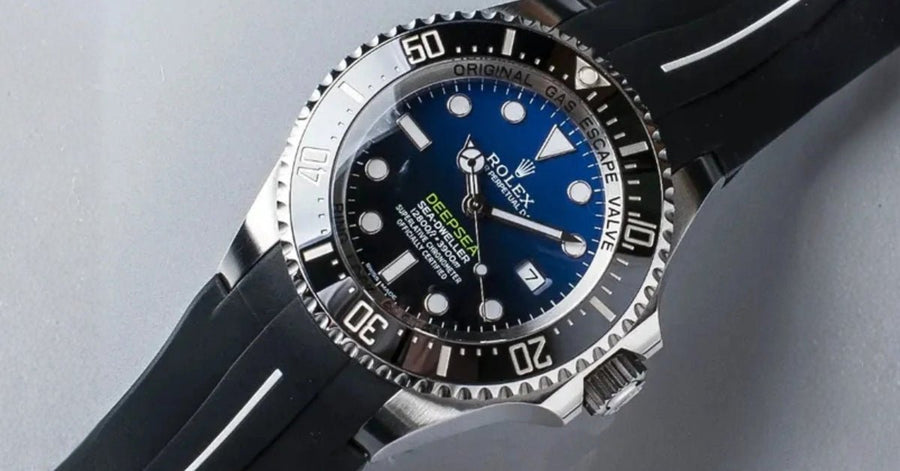
It will physically fit any Rolex sharing those lug widths, including the Submariner, GMT-Master II and Sea-Dweller. Plenty of customers do exactly that and are happy with the result. But be clear-eyed about it: those cases have curved lug profiles, and a straight-end strap will leave a visible gap between the strap and the case where a curved end would sit flush.
If you want that gap-free integrated look on a Submariner, a GMT-Master II, a Datejust or an Explorer, you want a curved-end strap instead. We make those for every major reference, and they're all in the main Rolex strap collection — along with our sailcloth, leather and alligator options.
Straight-end for Oysterflex models. Curved-end for everything else. It's the only fitment rule that really matters.
Changing the strap yourself
You'll need a spring bar tool. Ten minutes, one flat surface, a soft cloth so nothing rolls onto the floor.
- Lay the watch face-down on the cloth.
- Compress the spring bar at the 12 o'clock side and lift the strap section clear of the lugs.
- Repeat at 6 o'clock, then release both sections from the clasp.
- Attach the new sections to the clasp first — it's far easier than doing it in the reverse order.
- Fit each section into the lugs, seating the spring bars until you feel and hear them click into the drilled recesses.
- Tug firmly on both sides before you put it on. If either moves, reseat it.
If you'd rather not do it yourself, any competent watchmaker will handle it in minutes.
Looking after it
Rinse it under warm water after swimming — salt and chlorine are the two things that shorten any strap's life. A drop of mild soap and a soft brush clears the underside cushions when they collect dust. Dry it before storing.
FKM tolerates far more than you'll ever throw at it, but a strap that's rinsed occasionally will still look new in five years. One that isn't, won't.
Frequently asked questions
Can you buy a Rolex Oysterflex bracelet separately? Not through Rolex. The Oysterflex is only supplied fitted to watches that ship with it, and authorised dealers won't sell one over the counter or fit one to a model it wasn't made for. The aftermarket is the only route to a spare, a different length or a different colour.
Will an Oysterflex strap fit my Submariner? Physically, yes, if your Submariner has 20 mm lugs. Aesthetically, expect a small gap at the case where the curved lug profile meets the straight strap end. For a flush fit, choose a curved-end strap from our Rolex collection.
Does it work with my original Rolex clasp? Yes. That's the whole design. The strap connects to your existing Oysterlock clasp, so Glidelock adjustment stays exactly as it is.
What lug width does my watch take? Gold Daytona and Yacht-Master 40: 20 mm. Yacht-Master 42 and Sky-Dweller: 21 mm. Yacht-Master 37: 18 mm. If you're unsure, measure between the lugs with a caliper or ask us with your reference number to hand.
How long does a rubber strap last? A well-made FKM strap will comfortably see out several years of daily wear. Ours carry a lifetime warranty against manufacturing defects, which should tell you what we expect of them.
Can I order two different lengths? Yes — each side is selected independently. Mixed configurations like 60/50 are common and often produce the best fit.
Do you ship internationally? Free worldwide shipping, with no import fees for the customer.
Is this an original Rolex part? No, and we don't pretend otherwise. It's an independently manufactured aftermarket strap designed to fit Oysterflex-equipped models.
The short version
The Oysterflex is a superb piece of design let down by one thing: you get it in a single colour, at a single fitted length, and you get it on Rolex's schedule.
A made-to-fit FKM replacement solves all three at once — your choice of ten colours, your choice of length on each side, your original clasp retained, and in your hands in days rather than months. If you're replacing a worn factory strap, start with black. If you're building a rotation, the full Oysterflex collection is where to browse. And if your Rolex has curved lugs rather than Oysterflex ones, the Rolex strap collection has the right shape for it.
Lifetime warranty. Free worldwide shipping. In stock now.
Helvetus is an independent brand and is not affiliated with, authorised by, or endorsed by Rolex. Rolex®, Oysterflex®, Oysterlock® and Glidelock® are registered trademarks of Rolex SA. All Helvetus straps are aftermarket accessories; no watch is included.