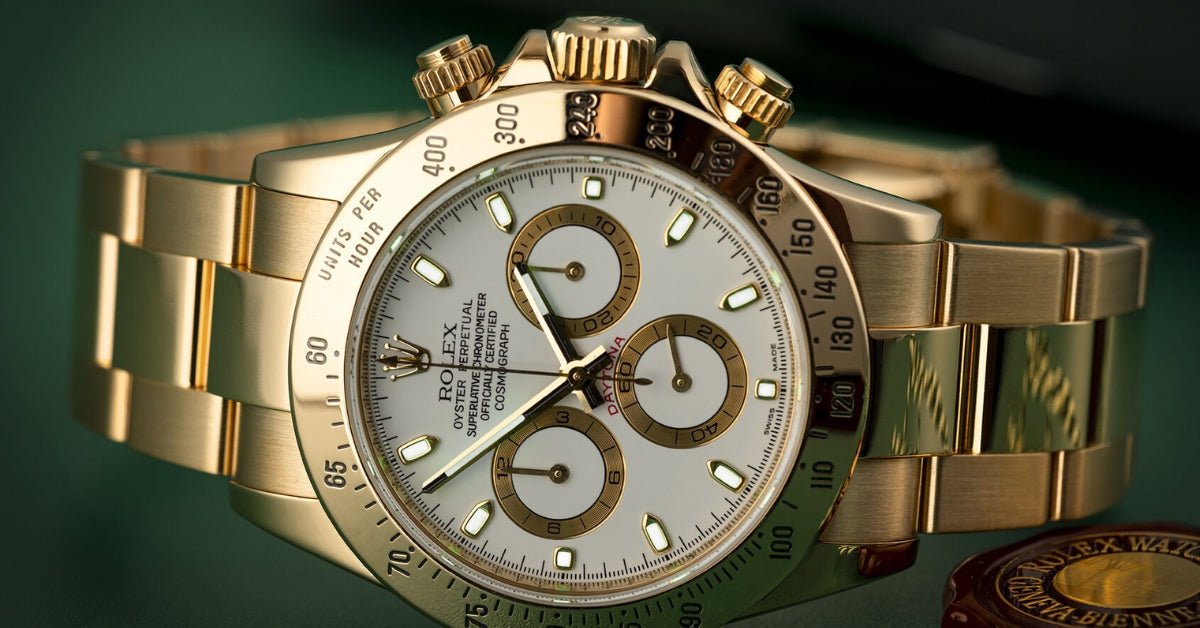
The 116528 is a Cosmograph Daytona made entirely of 18k yellow gold — case, bezel, pushers, crown, bracelet, all of it — with Rolex's first in-house chronograph movement inside. It arrived in 2000 alongside the steel 116520 and the two-tone 116523, and it stayed in the catalogue for sixteen years.
It's also, in most collections, the watch that doesn't get worn. Forty to fifty thousand dollars of solid gold on a bracelet does not encourage casual use, and that's a shame, because underneath all of it is a proper racing chronograph. A strap is the shortest route to actually using it.
Strap size and fit for the Daytona 116528
The 116528 is a 40mm case with a 20mm lug width — the same as every automatic Daytona.
There's no size to select at Helvetus. The curved Daytona straps are made at 20mm and shaped to this case:
→ All rubber straps for the Rolex Daytona
Make absolutely sure you have a 116528 and not a 116518
This is the most important paragraph in this guide, because these two are the easiest mix-up in the entire Daytona range. Same year, same 18k yellow gold, same gold bezel — but the 116518 came on a leather strap, not a bracelet, and these curved straps are built for bracelet Daytonas.
The bezel tells you which one you have. On the 116528, the engraved tachymeter numbers are thin, they sit next to small circular markings, and they all face the same direction when you look at the watch straight on. On the 116518, the numbers are fatter, the markings are triangular, and the numerals follow the curve of the bezel, pointing outward.
If yours is the 116518 or any Oysterflex Daytona, you want the Oysterflex replacement line instead.
On buckles: the pin buckle version includes its own steel buckle and is the straightforward choice. If you'd rather keep your original clasp with the deployant version, send support your reference first — this is a pre-2016 gold Oysterlock and it's worth thirty seconds of checking rather than a return on a watch like this.
What the 116528 actually is
Rolex launched it in 2000, the year the calibre 4130 replaced the Zenith-based movement that had powered Daytonas through the nineties. It's Rolex's first in-house automatic chronograph: column wheel, roughly 72 hours of reserve, Parachrom hairspring.
The case is 40mm in solid 18k yellow gold with screw-down pushers and a screw-down crown, good for 100 m. The bezel is gold with an engraved tachymeter scale. The bracelet is a gold Oyster with an Oysterlock clasp and the Easylink extension. Dials ran black, white, champagne and mother-of-pearl, with diamond-set versions on top of that.
In 2016 the 116508 replaced it — same case size, same movement, different bezel engraving, and the current full-gold Daytona. Today the 116528 generally trades somewhere around $40,000 to $50,000.
Why a solid gold Daytona belongs on rubber more than any other Rolex
Polishing a gold bracelet is subtraction. This is the argument, and it applies here more than to any two-tone or steel watch. Steel can be refinished more or less indefinitely. Gold cannot — every polish physically removes metal, and on a watch where the bracelet is solid 18k and a serious share of the total value, that metal doesn't grow back. A gold Oyster that's been through three or four refinishes has thinner links and softer edges, and both are permanent.
The scratches are unavoidable if you wear it. So don't wear it on the bracelet every day.
The gold that defines the watch stays exactly where it is. Case, bezel, pushers, crown, dial furniture — none of it goes anywhere when the bracelet comes off. Nobody has ever looked at a gold Daytona on rubber and thought it was the steel one. What leaves is the weight and the wear surface.
And it's a chronograph. Screw-down pushers, tachymeter scale, three registers. This watch was designed to be operated, and gold-bracelet Daytonas almost never are, because the whole package feels too precious to knock about. On rubber it drops a noticeable amount of weight, stops sliding around on the wrist, and starts behaving like the tool it's descended from.
Four strap colours for the 116528
1. Black — the one that makes the gold louder
Counterintuitive but true: black rubber doesn't tone a gold Daytona down, it turns the gold up. Against black, every warm surface on the watch — bezel, case flanks, markers, hands — separates cleanly and reads brighter than it does against more gold.
It's also the most versatile thing you can put on this reference, and the one to buy first if this is going to become a watch you wear rather than store.
→ Black rubber strap for the Rolex Daytona
2. Brown — for the champagne dial
The champagne-dialled 116528 is all one temperature: gold case, gold bezel, gold markers, warm dial. On a gold bracelet that can tip into a single undifferentiated mass. Brown rubber gives it a base — something warm but darker, so the dial and case have somewhere to sit.
This is the combination that makes a gold Daytona look considered rather than simply expensive.
→ Brown rubber strap for the Rolex Daytona
3. White — for the white and mother-of-pearl dials
If your dial is white or MOP, a white strap runs that brightness all the way down the wrist and leaves the gold as the only colour in the composition. It's the summer setup, and it's the one that photographs best by a distance.
Mother-of-pearl in particular comes alive next to white rubber, because nothing is competing with the iridescence.
→ White rubber strap for the Rolex Daytona
4. Navy — the one you can wear to work
Navy against yellow gold is the oldest reliable pairing there is, and on a watch this loud it does something useful: it makes the 116528 look deliberate under a jacket sleeve instead of celebratory.
It's darker and calmer than black is bright, and it's the pick for anyone who wants to wear a gold Daytona without announcing it.
→ Navy rubber strap for the Rolex Daytona
The rest of the range, including grey, green, beige, red and the LuxLine® options, is in the Daytona collection.
Related references
- 116508 — the ceramic-bezel gold Daytona that replaced it in 2016. Same 40mm case, same 20mm fit.
- 116503 — the two-tone of the same family.
- 116523 — the two-tone predecessor to the 116503, same case and fit.
- 16528 — the Zenith-powered gold Daytona that came before this one. Also 40mm and 20mm.
- 116518 / 116519 / any Oysterflex reference — leather or Oysterflex from the factory. Different strap system entirely.
Quick answers
What lug width is the Rolex Daytona 116528? 20mm, on a 40mm case. Every automatic Daytona uses 20mm.
Do I need to select a size? No. The curved Daytona straps are pre-sized at 20mm for this case.
How do I tell a 116528 from a 116518? Look at the bezel engraving. Thin numbers with circular markings all facing the same way is the 116528, and it came on a gold bracelet. Fatter numbers with triangular markings following the bezel curve is the 116518, which came on leather.
Will rubber look cheap on a solid gold watch? It's the opposite. Gold on black rubber is a combination Rolex itself now sells across the Oysterflex range — the contrast flatters the metal, and it's how most gold sports watches are worn today.
Before you order
A gold Daytona that lives in a safe isn't doing anything for anyone. Put it on rubber and it becomes a watch you can wear to lunch, on holiday, in summer, without doing irreversible damage to the most expensive bracelet Rolex makes.
Helvetus straps for the Daytona are cut for the 40mm case, come with a lifetime warranty on rubber, ship free worldwide with no import costs, and are worn by 50,000+ customers. The gold Oyster goes in the box. The chronograph goes back on your wrist.