Most strap guides have to argue that rubber belongs on the watch. This one does not, because Omega already sold this exact watch on a blue rubber strap.
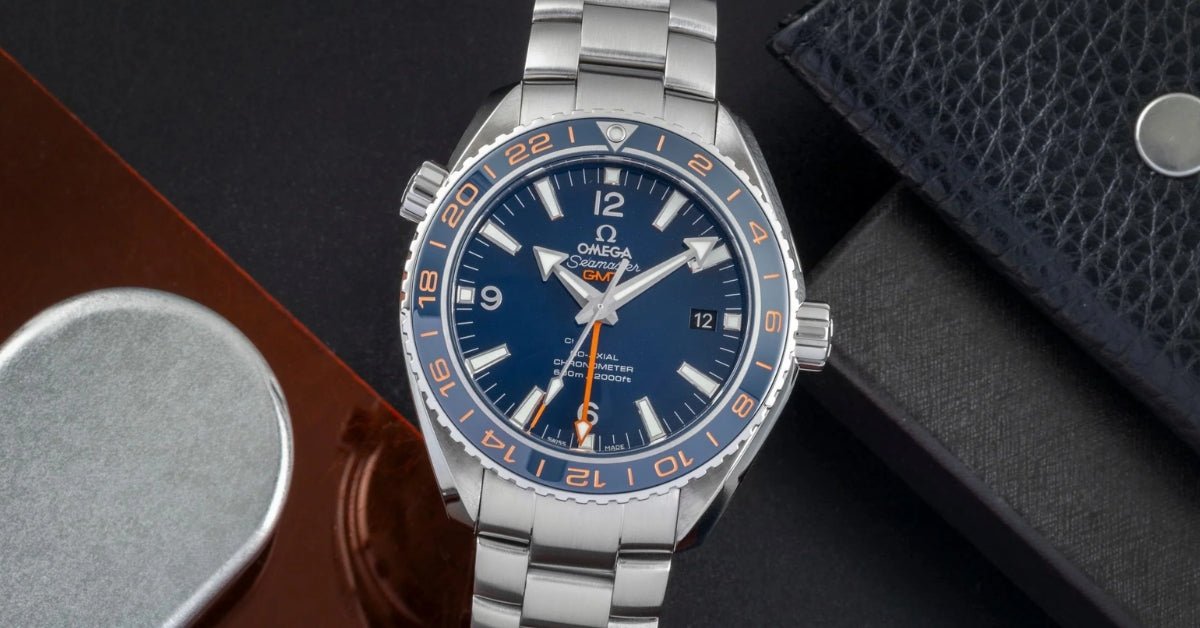
Your reference is 232.30.44.22.03.001, the GoodPlanet GMT on the steel bracelet. Change one digit — 232.32 — and it is the identical watch, same year, same dial, same bezel, fitted to blue rubber at the factory.
So the question here was never whether. It is only which.
The fit: 21mm
The GoodPlanet is the 43.5mm Planet Ocean case, and the lug width is 21mm — not 20mm, and not 22mm. That number catches people out because it sits between the two most common sizes in watchmaking, and a 20mm strap on these lugs leaves a visible gap on both sides.
Every strap in our Planet Ocean collection offers 21mm, so select 21mm and ignore the rest of the dropdown. Straps are cut 125mm + 75mm, spring bars are included, and the buckle to pick is silver on a brushed steel case.
If you would rather not lever spring bars near the lugs yourself, the Omega strap installation tool handles it.
What you own
A 2014 special edition. A 43.5mm brushed steel case with polished bevelled edges, 49.2mm lug-to-lug and around 17.3mm thick, water resistant to 600 metres, with a helium escape valve at 10 o'clock.
The dial is blue with applied indexes and a date at 3. The bezel is a polished blue ceramic ring with the GMT scale in bright orange, bi-directional, and the GMT hand is orange aluminium to match it. Inside is the Co-Axial calibre 8605 with a silicon balance spring, chronometer certified, running a second time zone. The bracelet is the 1679/603 with a diver's wet-suit extension.
And it weighs 215 grams on that bracelet.
The name is not decoration. Omega built the GoodPlanet edition in tribute to the GoodPlanet Foundation and committed a portion of the proceeds from every watch sold to fund a project preserving mangroves and seagrasses in Southeast Asia, and to educating local communities about protecting them. It came in its own hardwood box. If you bought this reference, you probably bought it partly for that.
Why this one comes off the bracelet
Three reasons, and the third is the one nobody mentions.
It is a 600-metre dive watch and the bracelet is the part that hates the sea. Salt water gets into every link and every pin, and getting it back out means rinsing and drying the whole thing properly, every time. Rubber rinses under a tap and dries in minutes.
215 grams is a lot of watch. At 43.5mm across and over 17mm tall this is already a substantial thing on the wrist; the bracelet adds most of the weight. Rubber takes a large chunk of that away without changing anything about how the watch looks from above.
And the bracelet is the one part you cannot replace cheaply. A GoodPlanet with its original 1679/603 and an unmarked wet-suit extension is worth more than one without. Wearing rubber for the daily grind is how you keep it that way.
Four that work
You have exactly two colours: blue and orange. Everything below is a decision about how much of each.
1. Blue with an orange line — the dial, exactly
Start here, because nothing else we make matches an Omega this literally. Your dial is blue, your bezel ring is blue, your GMT hand is orange and your bezel numerals are orange. This strap is blue with an orange line running down it.
It is the same two colours in the same proportion — a lot of blue, a little orange — and the result looks like a factory configuration rather than an aftermarket one. Given Omega's own rubber version of this watch is blue, that is not far from the truth. If you buy one strap for this reference, buy this one. Blue/Orange rubber strap →
2. Black with an orange line — keep the orange, lose the blue
The version for anyone who finds blue-on-blue too much of a good thing, and it is a legitimate objection: a blue strap under a blue dial and a blue bezel makes for a very blue watch.
Swap the strap body to black and the orange stays — still answering the GMT hand and the bezel scale — while the blue is confined to the watch itself and reads more intensely for having nothing to compete with. This is the more wearable of the two. Black/Orange rubber strap →
3. Full black — let the watch be the only colour
The neutral, and on a two-colour watch it does real work. Plain black rubber puts nothing on your wrist at all, so the blue dial and the orange hand become the only colours anywhere in the picture.
It is also the least conspicuous way to wear a 43.5mm orange-and-blue dive watch, which some days is exactly what you want. Full Black rubber strap →
4. Black with a white line — the cool option
The odd one out, and worth trying. White is the only other tone on the watch — the applied indexes, the lume, the marker at the top of the bezel — and a white line picks it up without touching either of the two main colours.
Against a blue and orange watch it reads cooler and more technical than the orange-lined version, and on a case this large a lengthwise line helps it look narrower than it is. Black/White rubber strap →
Related guides
- All Omega strap guides — including the other Planet Ocean sizes, which do not all share your 21mm
Ready to change it?
Helvetus is one of the largest names in aftermarket luxury watch straps, and our Omega straps are cut to specific cases rather than trimmed from a universal blank — which is why 21mm is on the menu at all, instead of being rounded to the nearest common size.
All rubber straps carry a lifetime warranty. Shipping is free worldwide, there are no import costs wherever you order from, and more than 50,000 customers have already made the swap.
Browse all Planet Ocean straps → See the full Omega strap range →
Helvetus is not affiliated with Omega SA. Model names are used for compatibility reference only.