If you own the 39mm Aqua Terra and you look up strap advice for an Aqua Terra today, you will be told to order 19mm.
Do not. Your watch takes 20mm. The 19mm figure belongs to the modern 38mm case, which replaced yours. Two Aqua Terras, one millimetre apart in case size, one millimetre apart in lug width, and everything written about the current range applies to the other one.
That single detail is the most useful thing on this page, so it goes first.
The fit: 20mm, not 19mm
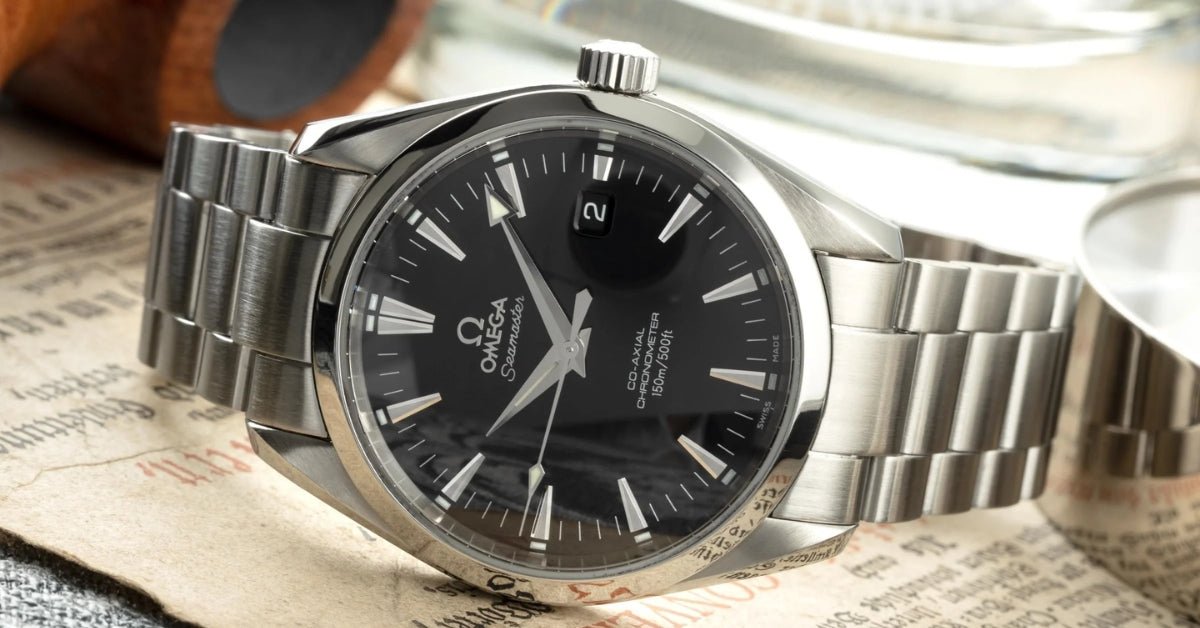
The 2503.50.00 is a 39mm case with a 20mm lug width. It is one of the reasons owners hold onto these — 20mm is the most common strap size in watchmaking, so the older Aqua Terra is genuinely easier to dress than its replacement.
Two collections here will fit it, and it is worth knowing why:
- Our Aqua Terra straps are built around this model family and run 18mm, 19mm, 20mm and 21mm. Select 20mm. The dropdown opens on 18mm, so change it before you add to cart, and set Buckle Colour to Silver if your watch came on the bracelet — that dropdown defaults to "No Buckle," which only suits someone reusing an Omega deployant they already own.
- Our Seamaster 300 straps name your reference — 2503.50.00 — directly in their compatibility list, and run 20mm, 21mm and 22mm. Same 20mm, a different set of colours.
Spring bars come with every strap either way, and the Omega strap installation tool makes the swap quick.
What you own, and why it still gets bought
Omega launched the Aqua Terra in 2002 as the civilised end of the Seamaster line — the successor to the Seamaster 120, meant for people who wanted the water resistance without the dive bezel. The 2503.50.00 is the black-dial 39mm from that first long generation: a smooth-bezel steel case with a screw-down crown, a display caseback, a date window at 3 o'clock, and the Co-Axial calibre 2500 inside.
Here is the number that matters, and it is the reason these keep selling twenty years on: around 11mm thick, with a 47mm lug-to-lug.
Compare that to the current 41mm at over 13mm and it stops being a small difference. The 2503.50.00 is the thinnest Aqua Terra Omega has made in the modern era, and it is the one that genuinely disappears under a shirt cuff rather than merely claiming to. Owners also point out something the spec sheet doesn't: this generation has a cleaner dial than the 8500 and 8900 models that followed, with no printed numbers ringing the outside.
Thin, plain, 20mm lugs, no bezel to argue with. It is arguably the easiest Omega in existence to put a strap on.
Choosing for a thin watch rather than a loud dial
Every other Aqua Terra guide we write starts with dial colour, because the modern range sells teak dials in blue, silver, green and turquoise and the dial is the loudest thing about them.
This one is different. Your dial is black, plain and quiet. The interesting variable here is not colour — it is proportion. At 11mm on a 47mm lug-to-lug, the watch reads as dress-sports rather than sports, and the strap either protects that or throws it away.
The rule that follows is simple: dark and clean keeps the watch looking as thin as it is. Anything busy adds visual height that the case does not have.
Four that work.
1. Full black — protect the proportions
Start here, and on this reference it is more than the safe answer. A dark strap running uninterrupted from the lugs reads as a continuation of the case rather than a separate object bolted underneath, and the whole watch stays visually low. Put the same watch on something pale or heavily patterned and it suddenly looks like a thin case sitting on a thick base.
It is also the most useful strap this watch could wear. A black-dial, 39mm, 11mm-thick Omega on black rubber goes everywhere without a thought. Full Black rubber strap →
2. Black with a white line — the tailored version
The same discipline with one detail added. A fine white line down a black strap is the strap equivalent of a pocket square: it reads as deliberate and slightly formal, and it costs you nothing in visual height because the strap is still dark.
This is the pick if the Aqua Terra is your one watch and it has to work with a jacket as often as it works without one. Black/White rubber strap →
3. Blue with a white line — make it read current
Worth saying plainly: this reference is now around twenty years old, and on its original bracelet it can look its age. A blue and white strap is the fastest way to stop that. It is a modern combination on a design that never went out of date, and against a plain black dial there is nothing for it to clash with.
If people keep asking whether your watch is new, this is why. Blue/White rubber strap →
4. Light blue — the one a thin watch earns
Thin watches are the ones you actually wear in hot weather, because they do not catch on a cuff and they do not sit up off the wrist. That makes this the Aqua Terra most worth owning a summer strap for.
Pale blue against a black dial is high contrast without being loud, and it makes the case look brighter and slightly larger — useful if 39mm sits on the small side for you. Light Blue rubber strap →
Owners of the other Aqua Terras
The sizes do not follow a pattern, so check yours:
- This 39mm (2503.x) — 20mm.
- Modern 38mm — 19mm. Different watch, different number.
- Modern 41mm — 20mm, same as yours. See the Aqua Terra 41mm guide.
- 43mm Worldtimer — 21mm. See the Worldtimer guide.
- Everything else Omega — the full index of model guides.
Ready to change it?
Helvetus is one of the largest names in aftermarket luxury watch straps, and our Omega straps are cut to specific cases rather than trimmed from a universal blank — which is why 20mm sits on the menu alongside 19mm rather than in place of it.
All rubber straps carry a lifetime warranty. Shipping is free worldwide, there are no import costs wherever you order from, and more than 50,000 customers have already made the swap.
Browse all Aqua Terra straps → See the full Omega strap range →
Helvetus is not affiliated with Omega SA. Model names are used for compatibility reference only.